Mathematics and Beauty: The Proof That Was Always in Front of Us
Mathematics and Beauty: The Proof That Was Always in Front of Us
There is a moment, familiar to anyone who has spent time with both mathematics and the visual world, when the two collapse into each other. When you see the spiral of a galaxy and recognise in it the same proportion that governs the growth of a nautilus shell and the spacing of seeds in a sunflower head and the relationship between the joints of a human finger. When you realise that what you are looking at is not a coincidence — that the same equation is writing itself across every scale of the observable universe, from the microscopic to the cosmic, with a consistency that no accident could produce.
That moment is the subject of this article. Not mathematics as an abstract discipline. Not beauty as a subjective preference. But the relationship between them — the possibility, which the evidence increasingly supports, that beauty is not in the eye of the beholder at all. That it is, at least in significant part, a perception of mathematical truth.
The Question Nobody Agrees On
Beauty has been argued about for as long as human beings have been capable of argument. Is it objective or subjective? Universal or culturally constructed? A property of the thing perceived or a response of the person perceiving?
The honest answer is that it is almost certainly both — that there are elements of aesthetic response that vary with culture, personality, and individual history, and elements that appear with a consistency across cultures and individuals that suggests something more fundamental is operating beneath the variation.
It is in that second category — the elements of beauty that appear consistently, across populations that have had no contact with each other, in response to forms and proportions that recur in the natural world — that the relationship between mathematics and beauty becomes most interesting. Because the things that most reliably produce the experience of beauty across the widest range of human observers are precisely the things that are most mathematically precise in their organisation.
The golden ratio. The Fibonacci sequence. Fractal self-similarity. Bilateral symmetry with controlled variation. These mathematical structures appear in the forms that human beings across every culture have consistently found most beautiful — in the proportions of the human face and body, in the forms of flowers and shells and landscapes, in the architecture and music and visual art that different cultures have independently produced as their most significant aesthetic achievements.
This is not proof of anything simple. But it is evidence of something real. And understanding what that something is — why mathematical structure produces the experience of beauty — is one of the most interesting questions available to anyone working at the intersection of design, architecture, and human experience.
The Golden Ratio and the Body That Reads It
The golden ratio — approximately 1.618, the proportion that results when a line is divided such that the ratio of the whole to the larger part equals the ratio of the larger part to the smaller — appears in the natural world with a frequency that continues to surprise researchers who look for it carefully. In the spiral of the nautilus shell. In the arrangement of seeds in a sunflower head. In the branching of trees and rivers and blood vessels. In the proportions of the human body — the ratio of the full height to the height of the navel, the ratio of the forearm to the hand, the ratio of the finger sections to each other.
It also appears, with striking consistency, in the objects and spaces that human beings across different cultures and historical periods have found most beautiful. In the proportions of the Parthenon. In the compositional structure of paintings that have sustained aesthetic regard across centuries. In the proportions of musical intervals that different cultures have independently identified as most consonant. In the dimensional relationships of faces rated as most attractive across populations with no shared cultural framework.
The question is why. What is it about this particular proportion that produces the experience of beauty so consistently?
One answer is familiarity — that we find the golden ratio beautiful because we see it everywhere in nature, and our experience of nature has conditioned us to respond positively to it. This is plausible. But it does not fully account for the consistency of the response across individuals with vastly different relationships to the natural world, or for the immediacy of the response, which often precedes any conscious recognition of the proportion.
A more interesting answer is that the golden ratio is beautiful because it is efficient — because it represents the optimal solution to certain recurring problems of biological organisation, and the human visual system has learned to recognise efficiency as beauty because efficiency in a living system is a reliable indicator of health, vitality, and fitness. We find the golden ratio beautiful not because we have been taught to but because our perceptual apparatus evolved to identify it as a marker of biological integrity. The mathematics and the beauty are the same thing, read through two different instruments.
Fractal Beauty and the Nervous System
The research on fractal aesthetics is among the most compelling evidence for the relationship between mathematical structure and beauty. Studies consistently show that people find fractal patterns — patterns with self-similar complexity at multiple scales simultaneously — more aesthetically pleasing than patterns that are either too simple or too complex. And the level of fractal complexity that produces the strongest positive aesthetic response corresponds precisely to the level of fractal complexity found in natural landscapes.
This is not a coincidence. It is the signature of a perceptual system shaped by millions of years of immersion in natural environments. The human visual cortex evolved to process fractal complexity — to navigate environments where every level of examination yielded new information, governed by the same underlying organisational principles. It became extraordinarily good at this kind of processing. And the experience of encountering a pattern whose fractal complexity falls within the range that the visual cortex processes most efficiently — neither too simple to engage it nor too complex to resolve — is experienced as beauty.
What this means for designers and architects is significant. The fractal quality of a surface — whether it is the grain of ancient wood, the texture of hand-applied plaster, the recursive geometry of a carved pattern, or the self-similar branching of an organic structural system — is not a stylistic choice. It is a direct communication with the biological hardware of the people who will encounter it. A surface with the right fractal complexity will be experienced as beautiful by virtually everyone who looks at it, regardless of their aesthetic education or cultural background, because it is speaking in a language the nervous system evolved to understand.
This does not make aesthetic experience purely mechanical. The richness of beauty — the way it accumulates in an object or a space over time, the way it shifts with different qualities of light and attention, the way it interacts with personal history and emotional state — is irreducible to any simple formula. But it does suggest that mathematical structure is not incidental to beauty. That it is, at least in part, its foundation.
Music as Visible Mathematics
The relationship between mathematics and beauty is perhaps most legible in music — the art form whose materials are most explicitly mathematical and whose aesthetic effects are most consistently cross-cultural.
The consonant intervals that different musical traditions have independently identified as most pleasing — the octave, the perfect fifth, the perfect fourth — are the intervals whose frequency ratios are most mathematically simple. The octave is a ratio of 2:1. The perfect fifth is 3:2. The perfect fourth is 4:3. The intervals that different cultures have independently identified as most dissonant are the ones whose frequency ratios are most complex — least expressible in simple whole numbers.
This relationship between mathematical simplicity and musical consonance is not a culturally constructed convention. It is a physical fact — a consequence of the way harmonic series interact in the human auditory system. The experience of consonance is the experience of mathematical order perceived through the ear.
What music adds to this foundation is the movement between mathematical states — the tension and resolution, the departure from and return to mathematical simplicity, the experience of being held in a state of harmonic complexity before being released into consonance. The beauty of music is the beauty of mathematical relationships in time — of proportion extended into a temporal dimension that the visual arts can only approximate.
The greatest composers understood this with complete clarity. Bach's fugues are exercises in mathematical structure that produce aesthetic experiences of extraordinary depth. Not because the structure is perceptible as such — most listeners have no conscious awareness of the fugal logic they are hearing — but because the mathematical relationships between the voices produce, through the auditory system, a quality of ordered complexity that the nervous system processes as beauty. The mathematics and the music are the same thing.
Sacred Geometry as Applied Mathematics of Beauty
Sacred geometry is, at its most fundamental level, the systematic application of the mathematical principles that produce beauty to the design of objects and spaces. Not beauty in a narrow aesthetic sense — but beauty in the broader sense of forms that produce in the people who encounter them a quality of experience that purely arbitrary forms do not.
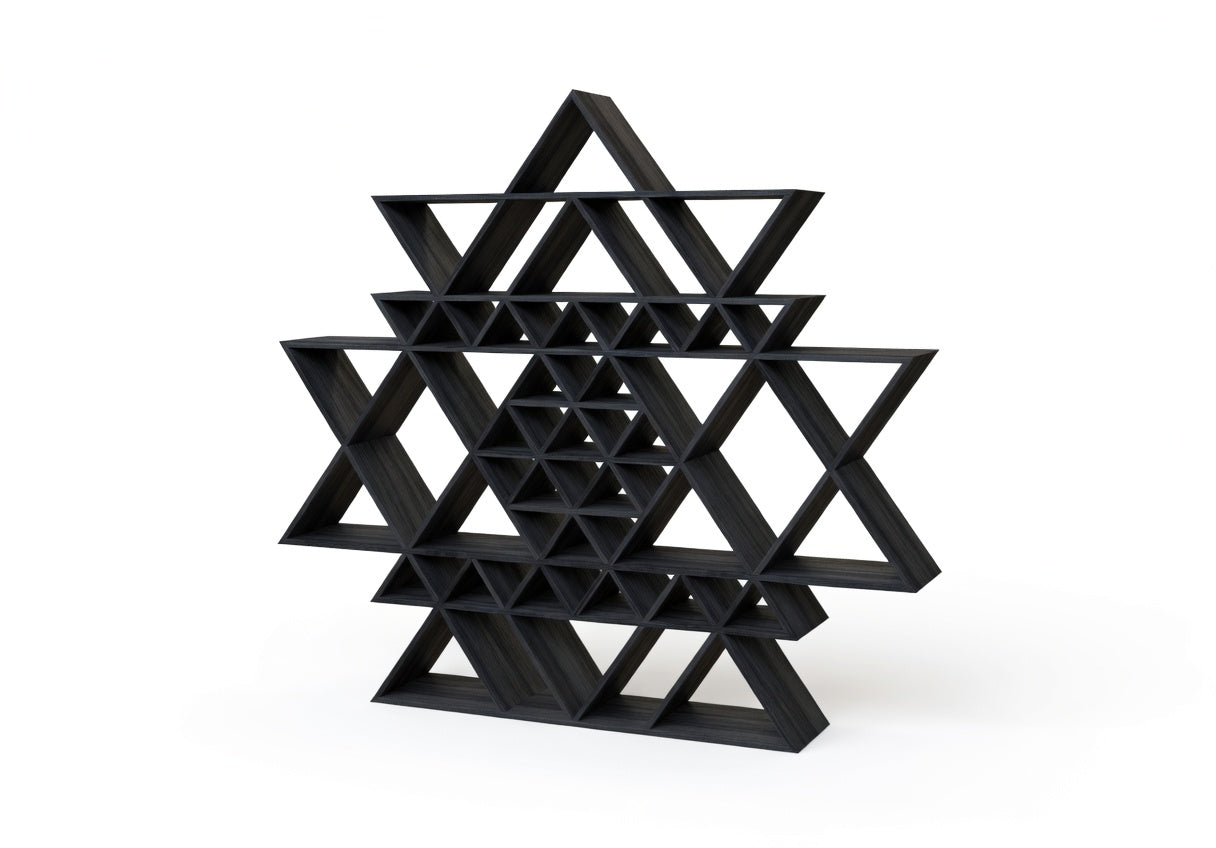
The golden ratio. The Fibonacci sequence. The geometric relationships of the Platonic solids. The self-similar logic of fractal structures. These are not design references in the way that a historical style or a material palette is a design reference. They are the mathematical principles underlying the forms that the human perceptual system processes most efficiently and finds most beautiful — and sacred geometry is the tradition that brings them to bear on the design of the built environment with the greatest deliberateness and precision.
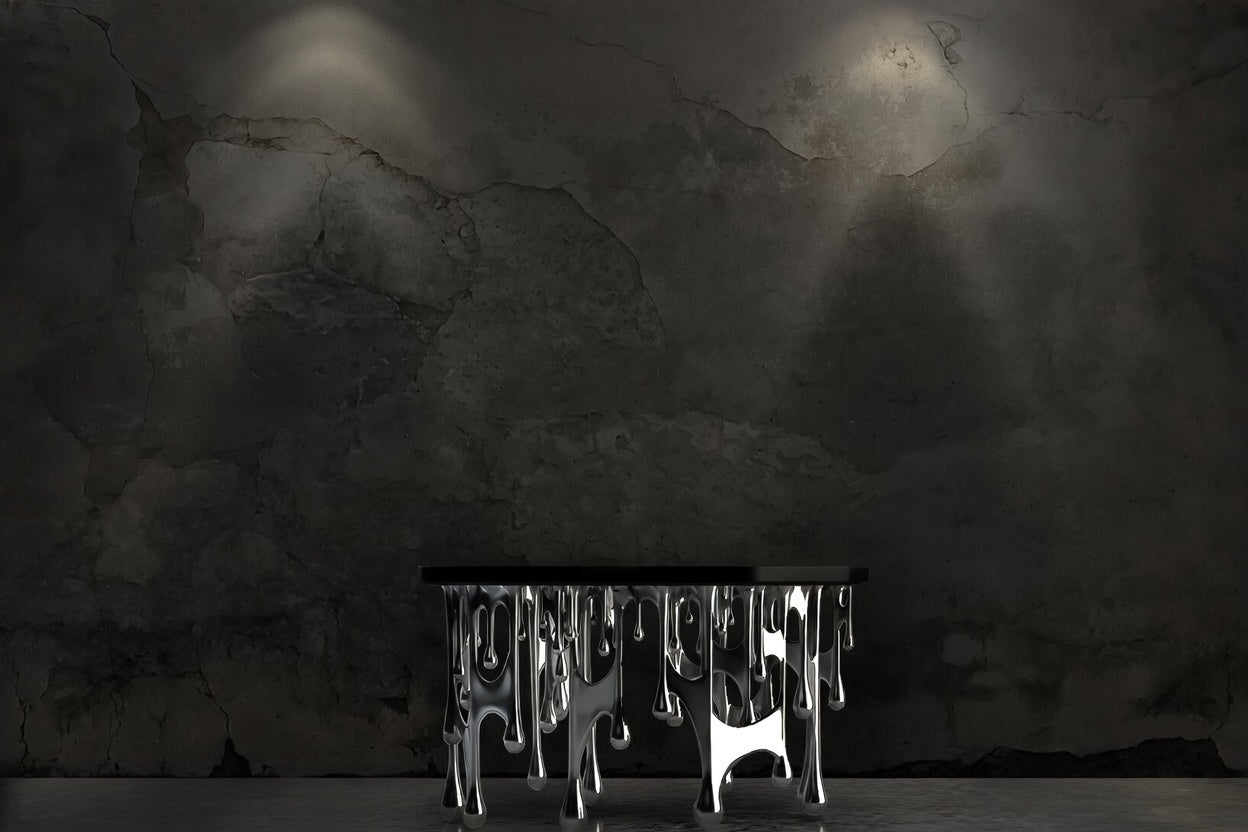
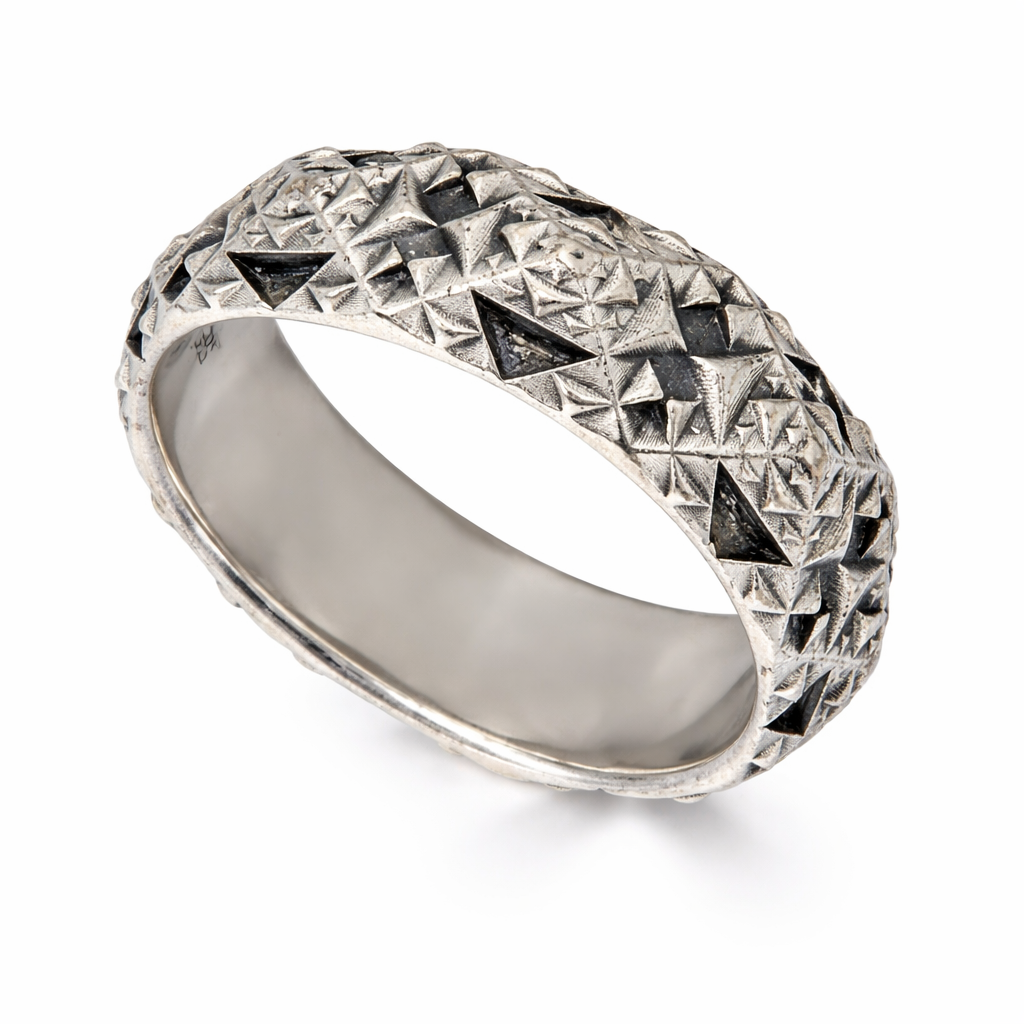
When I work with these principles — encoding them into the parametric algorithms that generate the forms of my furniture and jewelry, applying them to the proportional decisions that determine the spatial experience of an interior environment, using them to guide the selection and placement of materials whose inherent mathematical structure embodies them — I am not working from a stylistic preference. I am working from the most rigorous understanding available of what produces beauty in the human perceptual system and why.
The result is work that aims to be beautiful not in the way that trend-responsive design is beautiful — through the manipulation of current aesthetic preferences — but in the way that the Parthenon is beautiful, and the nautilus shell is beautiful, and the face of a person in the full presence of their own particular form of aliveness is beautiful. Through the embodiment of mathematical relationships that the human nervous system evolved to recognise and respond to as the signature of something real.
The Proof and the Mystery
None of this resolves the question of beauty into something simple. The relationship between mathematical structure and aesthetic experience is real and significant — but it is not the whole of beauty, and it would be a mistake to think it is.
Beauty also lives in the particular — in the specific quality of light on a specific surface at a specific moment, in the precise combination of elements that produces an experience no formula could have predicted, in the encounter between a person with their particular history and an object or a space with its particular qualities. These dimensions of beauty are not mathematical in any obvious sense. They are contingent, personal, irreducible.
What mathematics provides is not a theory of beauty that explains everything. It provides a foundation — a set of principles so fundamental to the way the human perceptual system works that any design that ignores them is working against the grain of human experience, and any design that embodies them has access to a quality of aesthetic resonance that purely intuitive or trend-driven work cannot reliably achieve.
The most interesting design work — the work that produces the deepest aesthetic experience and continues to reward attention across the longest time — is the work that holds both of these in relationship. That uses mathematical structure as its foundation without allowing it to become its limit. That understands the golden ratio and the fractal principle and the harmonic series not as rules but as the deepest available understanding of the territory in which beauty lives — and then explores that territory with the full range of intelligence, sensibility, and creative courage available to a person who has genuinely understood what they are working with.
The proof was always in front of us. In the shell. In the tree. In the face of the person we love. In the building that stopped us on the street before we understood why.
Mathematics did not create beauty. It described it. And in describing it, gave us the most powerful tools available for making more of it — with intention, with precision, and with the humility of people who understand that the intelligence they are applying is not their own invention but the universe's oldest habit.

John Brevardが執筆