
記事: British Virgin Islands
British Virgin Islands
Reimagining Eco Luxury in the British Virgin Islands: A five-star Resort Proposal


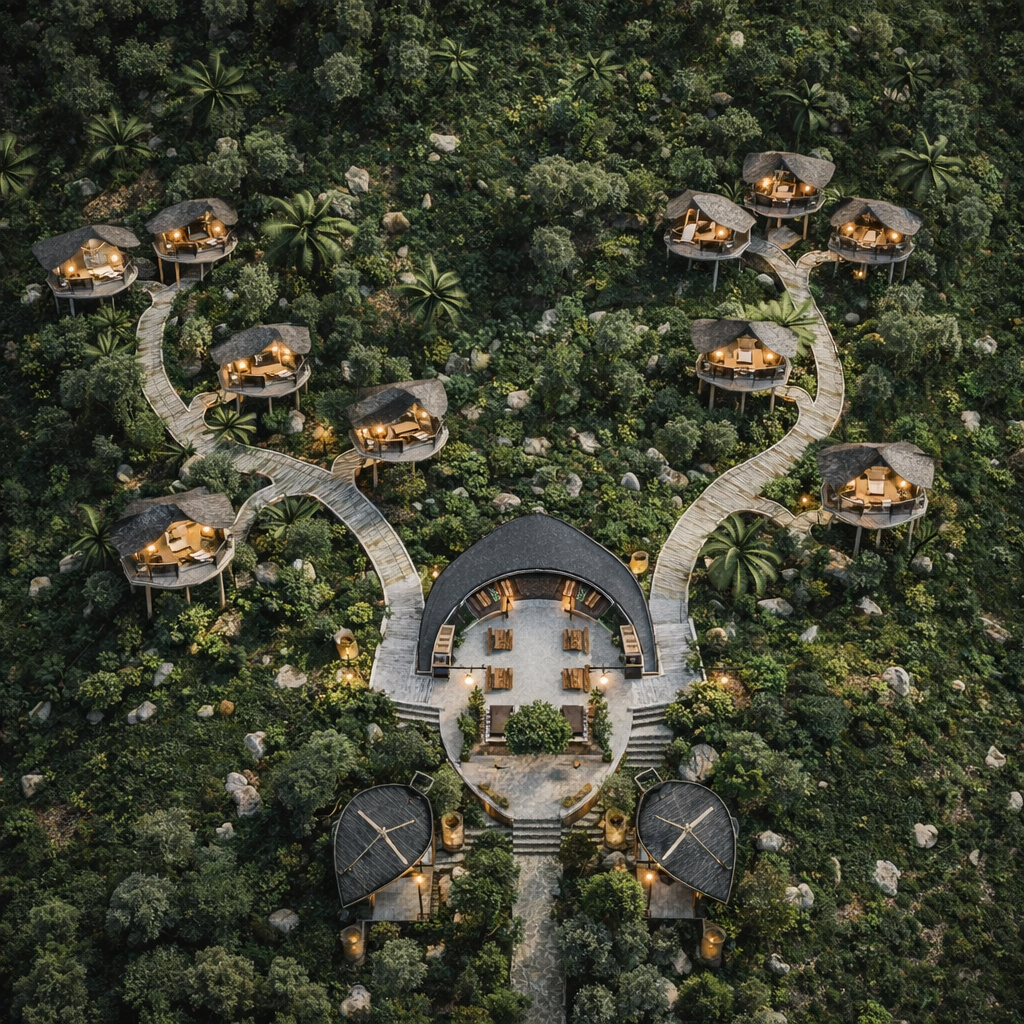
Set within the untouched landscape of the British Virgin Islands, this proposal explores a new model for eco-luxury hospitality. Conceived as an immersive environment rather than a singular architectural object, the project brings together private residences, a boutique hotel, a beach club, a spa, and a destination restaurant into a unified system embedded within nature.
The architecture does not impose itself on the land. It emerges from it, shaped by biomimetic principles, fractal geometries, and an understanding of natural systems. Each space is designed to exist in continuity with its surroundings, allowing landscape, structure, and life to operate as one. It is a place designed not only to be seen, but to be lived through light, movement, and sensory experience.
Architecture as Landscape

The project is defined by its relationship to the terrain. Rather than building above the site, the architecture is carved into it, following the natural contours of the island.
Roofs become extensions of the ground, planted and walkable. Pathways curve organically, guiding movement without rigid boundaries. Volumes are softened, shaped by erosion, wind, and growth rather than geometry alone.
This approach allows the architecture to remain visually discreet while creating spaces that feel protected, intimate, and open at once.
Biomimicry and Sacred Geometry


The formal language of the project draws from nature at multiple scales. Fractal logic informs both the overall masterplan and the smallest architectural details, creating a sense of coherence that feels instinctive rather than imposed.
Curved structures echo the growth patterns of plants. Branching columns and woven forms reflect natural systems of support and expansion. Circular and radial geometries introduce balance and continuity, reinforcing a spatial experience rooted in sacred geometry.
These elements are not decorative. They shape how space is experienced, how light enters, and how the body moves through the environment.
Program: A Living Hospitality Ecosystem

The proposal is conceived as a complete hospitality and residential system.
Private residences are embedded within the hillside, offering privacy while remaining connected to the wider landscape. A boutique hotel extends this experience, creating a more collective rhythm without disrupting the terrain.
At the shoreline, the project opens into a beach club defined by sculptural cabanas and shaded structures that reinterpret traditional Caribbean typologies through a biomimetic lens. These spaces are designed not only for leisure, but for immersion, placing guests directly within the landscape rather than in front of it.
A signature restaurant becomes the social and architectural center of the project. Defined by branching, organic structures and open-air volumes, it frames the horizon while creating a spatial experience that evolves throughout the day, from quiet morning light to a more vibrant evening atmosphere.
Elevated dining terraces and panoramic viewpoints extend this experience further, introducing moments of suspension between jungle and ocean.
A wellness spa is positioned more discreetly within the terrain, offering a contrasting condition of stillness and retreat.
Circulation connects all elements fluidly, allowing movement across the site to feel continuous and intuitive.
Interior and Exterior as One

Materiality plays a central role in dissolving boundaries between inside and outside. Wood, stone, and natural fibers are used in their most honest form, allowing textures to age and evolve over time.
Large openings frame views of the ocean and vegetation, while filtered light creates shifting atmospheres throughout the day. Interiors are not enclosed spaces but extensions of the landscape itself.
Spaces extend outward into terraces, beach structures, and open-air environments, dissolving the boundary between architecture and experience.
Toward a New Definition of Luxury


This project proposes a different understanding of luxury. It is not defined by excess, but by connection. Connection to place, to climate, to material, and to time.
By embedding architecture within natural systems, the design reduces its visual and environmental footprint while enhancing the quality of experience.
In this context, luxury becomes something quieter and more essential. It is found in space, in light, and in the feeling of being fully integrated within a living environment.
Conclusion
This five-star resort proposal envisions a new model for hospitality in the British Virgin Islands. One where architecture is not an object placed onto the landscape, but a system that grows from it.
Through biomimetic design, fractal geometry, and a deep respect for nature, the project creates a destination that is both immersive and sustainable. A place where living, hospitality, and environment exist in balance.


John Brevardが執筆

