Biomorphic Furniture Design: When Objects Remember They Are Alive
Biomorphic Furniture Design: When Objects Remember They Are Alive
There is a particular quality of stillness that certain objects possess. Not the stillness of the inert or the unfinished — but the stillness of something that has arrived. That has found, through some process of resolution you cannot quite trace, the form it was always moving toward. You encounter it in a shell. In a worn river stone. In the particular curve of a branch where it meets the trunk. And occasionally, in a piece of furniture.
That quality is what biomorphic design is reaching for. Not the imitation of natural forms for aesthetic effect — but the application of the same organisational intelligence that produces those forms to the objects we live with every day. It is a more ambitious project than it appears. And when it succeeds, it produces work that operates on the person inhabiting it at a level beneath conscious appreciation.
The Intelligence of Natural Form
Nature does not design arbitrarily. Every form in the natural world is the result of a process of optimisation — the accumulated solution to a set of structural, environmental, and biological problems, refined across thousands or millions of generations until the most efficient answer emerged. The curve of a bird's wing is not beautiful by accident. It is beautiful because it is the aerodynamically optimal response to the problem of flight, and the human visual system — which evolved alongside natural systems and learned to read their efficiency as beauty — recognises this without being told.
This is the foundation of biomorphic design. Not that natural forms are aesthetically pleasing — though they are — but that they carry within them a kind of structural wisdom that purely geometric or arbitrary forms do not possess. That the curve which emerges from a biological growth process has been tested against reality in a way that a curve drawn from pure intuition has not.
When a furniture designer works biomorphically — when they derive the forms of their objects from the logic of natural growth, from morphogenetic processes, from the structural principles of living systems — they are not decorating with nature. They are borrowing nature's intelligence. Applying to the design of objects a set of principles that have been validated across timescales that dwarf the entire history of human making.
Morphogenesis and the Furniture Object
Morphogenesis — the biological process through which organisms develop their form — is one of the most extraordinary phenomena in the natural world. From a single fertilised cell, following a set of chemical and mechanical instructions encoded in its DNA, a living organism constructs itself into a form of staggering complexity and precision. No blueprint. No external direction. Just a set of local rules, applied consistently, producing global organisation of a kind that no top-down design process has ever matched.
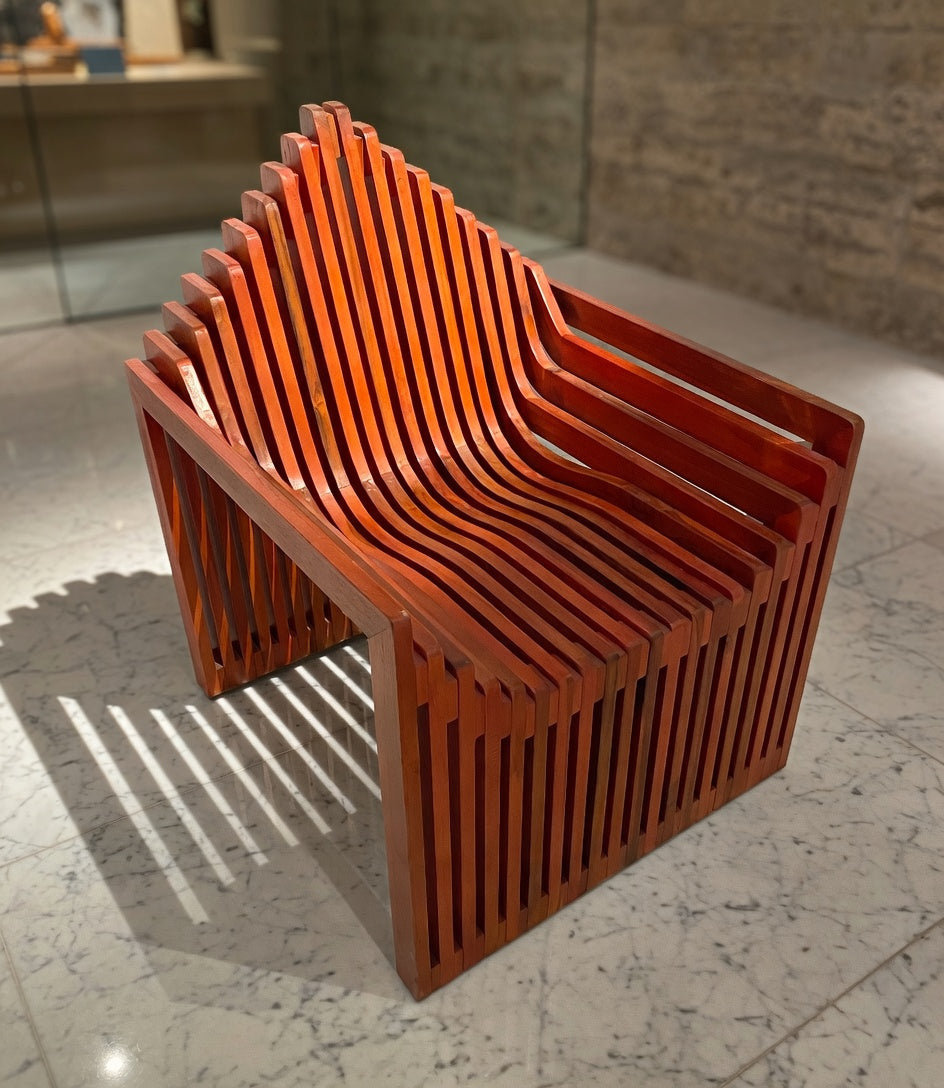
The furniture objects that interest me most are the ones that appear to have undergone something like this process — that seem to have grown into their forms rather than been constructed toward them. The parametric wood fin chairs and sofas I have developed over years of practice are attempts to apply morphogenetic logic to furniture design — to allow the form to emerge from a set of consistent rules applied across the full extent of the object, rather than being imposed from outside as a resolved silhouette.
Each vertical fin in these pieces follows the same logic as its neighbours, responding to the overall curvature of the form the way cells in a developing organism respond to the chemical gradients around them. The result is a surface that reads as continuous and organic at the scale of the whole object, but reveals at close examination the precise repetition of individual elements — the same tension between organic wholeness and structural clarity that characterises the most beautiful natural forms.
This is not a visual trick. It is a genuine application of biological organisational intelligence to the design of objects. And the people who encounter these pieces respond to it — not always consciously, but consistently — with the particular quality of attention that living things attract.
The Body Recognises Its Own
Human beings are biological organisms. The bodies we inhabit grew through morphogenetic processes. The nervous systems through which we perceive the world evolved in environments saturated with biomorphic form. And at some level that operates beneath conscious awareness, we retain the capacity to recognise the difference between forms that share the organisational intelligence of living systems and forms that do not.
This recognition is not cultural. It does not depend on knowledge of design history or biological science or sacred geometry. It is immediate and physical — a response of the nervous system to the presence of a particular quality of formal organisation. The same response that makes a worn river stone feel satisfying to hold. That makes certain coastlines feel more alive than others. That makes the experience of being in a forest — surrounded by biomorphic complexity at every scale — genuinely restorative in a way that being in a regular grid of any kind is not.
When furniture is designed with genuine biomorphic intelligence — when its forms emerge from the same principles that govern living systems rather than being applied as decoration — it carries this quality into the interior environment. The room becomes subtly more alive. Not in any mystical sense. In the specific sense that the nervous systems of the people inside it are receiving a different quality of environmental information — one that resonates with something deep in their biological makeup rather than simply registering as visually interesting.
This effect is subtle. It accumulates rather than announces itself. But it is the difference between a room you want to spend time in and a room you simply occupy. Between furniture you live with and furniture you merely own.
Materials That Already Know
The most powerful biomorphic furniture is often the work that allows the inherent biology of its materials to speak — that understands the organic intelligence already present in natural materials and designs in relationship with it rather than over it.
Solid teak, grown over eighty years in an Indonesian forest, carries within its grain the record of every season of its growth — the wet years and the dry ones, the years of rapid expansion and the years of slow consolidation. That grain is a biological document. A fractal record of the tree's morphogenetic history. When it is used in furniture design with enough restraint to let it be what it is — rather than being covered, painted over, or reduced to a uniform surface — it brings into the interior environment a quality of biological depth that no manufactured material can replicate.
Petrified wood carries this quality to its extreme. A material formed over hundreds of millions of years, the organic cellular structure of the original tree preserved in perfect mineral detail within a matrix of stone — it is simultaneously the most ancient and the most biologically precise material available to a designer. Its surface, under raking light, reveals a cellular geometry of extraordinary complexity — the actual record of living tissue from before the age of mammals, preserved in permanent geological form.
Cast zinc, poured around organic forms — coral, root structures, natural mineral formations — and allowed to cool in its own way, produces surfaces whose texture is determined by the intersection of thermal physics and biological geometry. The resulting forms carry within them the exact imprint of living systems — not as representation but as direct physical record. The coral is gone. Its geometry remains, fossilised in recycled metal.
These materials do not need biomorphic design imposed upon them. They are biomorphic — expressions of living intelligence preserved in material form. The designer's responsibility is simply to place them with enough intelligence and enough restraint that their inherent quality can be perceived.
Comfort as a Biological Fact
There is a practical dimension to biomorphic furniture design that is worth stating plainly. Forms derived from the structural logic of biological systems tend to fit the human body better than forms derived from purely geometric or arbitrary principles. Because the human body is itself a biological system — one whose proportions, movement patterns, and ergonomic requirements emerged from the same evolutionary processes that shaped the natural world — furniture that shares the organisational logic of living systems tends to accommodate it more naturally.
The curve of a biomorphically designed chair back is not beautiful and comfortable by coincidence. It is beautiful because it is efficient — because it follows the structural logic that produces efficient load distribution in natural systems — and it is comfortable for the same reason. The form that emerges from genuine biomorphic intelligence is simultaneously the most visually resolved and the most ergonomically considered, because visual resolution and ergonomic consideration are both expressions of the same underlying principle: the form that is optimally suited to its function.
This is why the greatest biomorphic furniture designers — from the mid-century masters who first brought organic form into the modern interior to the contemporary practitioners working with parametric tools and ancient natural materials — have consistently produced work that is both visually compelling and physically comfortable. The beauty and the comfort are not separate achievements. They are the same achievement, approached from two different directions.
The Object That Grows With You
There is a quality that the best biomorphic furniture shares with living things — the quality of continuing to reveal itself over time. A piece of furniture that was designed with genuine biological intelligence does not exhaust its interest quickly. The more time you spend with it, the more of its internal logic becomes visible. The relationships between its forms. The way its surface responds to different qualities of light. The particular quality of presence it brings to the room at different times of day and different states of mind.
This is the quality that makes certain objects worth living with for a lifetime — and worth passing on. Not their visual impact, which is immediate and therefore also immediately available to be consumed and moved past. But their depth, which takes time to reveal and rewards the patience of sustained attention with a continuously unfolding experience of formal intelligence.
Biomorphic furniture designed with genuine philosophical intention — with real engagement with the principles of natural form and the materials that embody them — has this quality of depth. It grows with the person who lives with it, revealing more of itself as their own capacity for attention develops. It is not a possession in the way that most furniture is a possession. It is more like a relationship. One that, if it was designed with enough intelligence and enough care, has the potential to outlast everything else in the room.
The Only Design That Was Never Invented
Every other design tradition was invented — created by human beings responding to cultural, technological, and historical conditions. Biomorphic design was not invented. It was recognised. It was always there, in the forms of the natural world, waiting for designers willing to look carefully enough and humble enough to learn from what they saw.
That humility — the willingness to subordinate personal invention to the intelligence already present in natural systems — is the defining characteristic of the best biomorphic work. It is not the absence of authorship. It is authorship of a particular and demanding kind: the authorship of the person who knows when to lead and when to follow, when to impose and when to yield, when to speak and when to simply create the conditions in which something more intelligent than any individual designer can emerge.
The natural world has been solving design problems for four billion years. The furniture that acknowledges this — that brings the accumulated intelligence of those four billion years into the rooms where human lives take place — is the furniture most worth making. And most worth living with.

作者:John Brevard