
Geometry in Ancient Temples: The Mathematics They Built With Before Mathematics Had a Name
Geometry in Ancient Temples: The Mathematics They Built With Before Mathematics Had a Name
This is not a coincidence. The beauty and the precision are the same thing — expressions of a single underlying intelligence that the builders of the ancient world understood with a clarity that contemporary architecture has largely lost. The geometry is not decoration applied to the building. The geometry is the building. Its proportions, its structural logic, its relationship to the movement of celestial bodies — all of it emerges from the same mathematical understanding, applied with an intention that was simultaneously practical, philosophical, and what we would now call spiritual.
We have been excavating that intelligence for centuries. We are still learning what it knew.
The mathematics that modern scholars use to analyse ancient sacred architecture — the golden ratio, the Fibonacci sequence, sacred geometry, fractal self-similarity — was in most cases formalised long after the buildings that embodied it were complete. The Parthenon was built in the fifth century BC. The formal mathematical description of the golden ratio came later. The Gothic cathedrals of medieval Europe encode proportional relationships that their builders understood through direct practice and transmitted through guild knowledge, without a theoretical framework that would be recognisable to a contemporary mathematician.
This matters because it means the geometry of ancient sacred spaces was not applied as a theory. It was discovered — through the accumulated observation of natural systems, through the experience of building and inhabiting spaces across generations, through the gradual refinement of a practical understanding of what works. What produces environments that feel resolved, that hold their inhabitants in a quality of attention that ordinary spaces do not produce, that continue to reward examination and habitation across centuries without exhausting their interest.
The builders of Karnak, of Angkor Wat, of the great mosque at Cordoba, of Chartres Cathedral — they were not applying sacred geometric theory. They were applying sacred geometric intelligence. The accumulated wisdom of traditions that had learned, through direct experience rather than abstract reasoning, that certain proportions and certain mathematical relationships produce certain qualities of spatial experience. And that the spaces intended for the highest quality of human experience — the spaces set apart from the ordinary world for the purposes of worship, contemplation, and encounter with the immeasurable — demanded the application of those principles with the greatest possible precision and care.
The Parthenon is the building most frequently cited in discussions of sacred geometry, and with good reason. Its proportions are derived from the golden ratio with a thoroughness and a precision that continues to astonish researchers who subject it to detailed mathematical analysis. The relationship between its width and its height. The spacing of its columns. The relationship between the diameter of a column and the space between columns. The subtle curvature of its stylobate — the platform on which it stands — and the entasis of its columns, which taper in a curve rather than a straight line. All of these are governed by the same proportional logic, applied at every scale of the building simultaneously.
What makes this extraordinary is not the mathematical sophistication it represents — though that is real — but the clarity of intention it reveals. The architects of the Parthenon understood that the proportions of a building are not neutral. That the relationship between its dimensions produces a specific quality of experience in the people inside and around it. And they chose, for a building intended as the dwelling of a goddess and the material expression of an entire civilisation's understanding of the relationship between the human and the divine, to use the proportions that they knew — from experience, from observation, from the accumulated knowledge of their tradition — produced the most profound quality of spatial experience available.
The Parthenon does not move people because it is old or famous or historically significant. It moves people because its proportions are derived from the same mathematical relationships that govern the growth of living organisms — and the human nervous system, which is itself a living organism governed by those same relationships, recognises them as home.
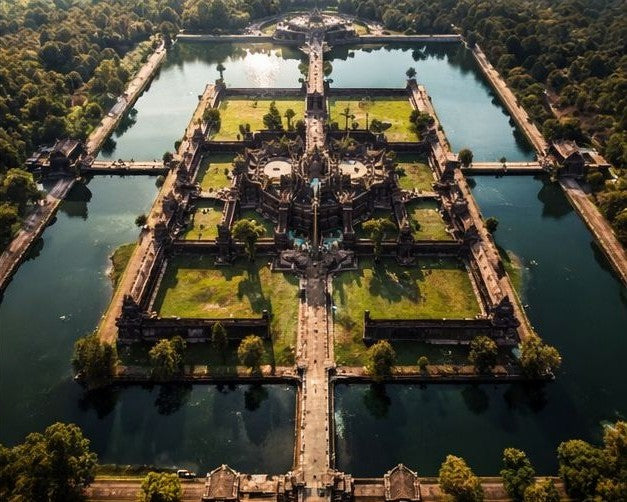
The temple complex at Angkor Wat in Cambodia is the largest religious monument ever built — a structure whose spatial organisation mirrors, with extraordinary precision, the cosmological understanding of the Khmer civilisation that built it. Its plan encodes the structure of the mythological universe: the central tower representing Mount Meru, the cosmic mountain at the centre of the world; the concentric enclosures representing the mountain ranges and oceans surrounding it; the causeways and gateways representing the transitions between cosmic zones.
But the cosmological program is not simply symbolic. It is geometric. The distances between the key architectural elements of the complex encode, in Khmer units of measurement, the numerical values of the Hindu and Buddhist cosmological cycles — the yugas, the vast periods of cosmic time through which the universe passes in its cycles of creation and dissolution. The building is literally a measurement of cosmic time expressed in architectural form.
What this means for the person moving through the complex — regardless of their familiarity with Hindu cosmology — is that they are moving through a space whose proportions were derived from the largest possible framework of reference: the structure of the universe itself. And the experience this produces — the particular quality of smallness and significance, of being located within something immeasurably larger than the immediate moment — is the experience the building was designed to produce.
The geometry is not decoration. It is the instrument through which the architecture achieves its primary purpose: the production of a specific quality of human consciousness. The consciousness of a person who understands, in their body rather than their intellect, that they are part of something larger than themselves.
The great Gothic cathedrals of medieval Europe are fractal structures — buildings whose organisational logic repeats at every scale from the overall massing of the building down to the finest carved detail of a capital or a door jamb. The pointed arch that defines the structural system of the whole building appears at every scale within it: in the vaulting, in the window tracery, in the carved decorative program, in the miniature architectural elements that adorn the choir stalls and the altar screens. The same form, the same proportional logic, the same structural intelligence — at every level of examination simultaneously.
This was not accidental. The medieval builders understood — through the Neoplatonic philosophical tradition that informed their theology, through the direct observation of natural systems, through the accumulated practical knowledge of their craft guilds — that forms derived from self-similar logic carry a particular quality of presence. That they read as complete at every scale of examination. That they reward sustained attention in a way that forms lacking this internal consistency do not.
The effect in the completed cathedral is extraordinary. No matter where you direct your attention — to the whole building from outside, to the nave from the west door, to a single bay of the vaulting, to the carved detail of a single capital — you encounter the same quality of intelligence, the same proportional logic, the same formal resolution. The building is equally present at every scale. It cannot be exhausted by looking. And this quality of inexhaustibility — the quality that makes certain buildings worth returning to across a lifetime — is precisely the quality that their fractal geometric organisation produces.
The Gothic master builders did not have Mandelbrot's mathematics. They had something more immediately powerful: direct experience of what this quality of geometric intelligence does to the people inside the spaces it creates. And they applied it, in service of the highest ambitions their civilisation was capable of expressing, with a precision and a consistency that remains extraordinary eight centuries after the last of the great cathedrals was completed.
The Islamic architectural tradition represents perhaps the most mathematically sophisticated application of sacred geometry in the history of building. The tilework, the carved plasterwork, the wooden screens and lattices that characterise the great mosques and palaces of the Islamic world are not ornamental in any conventional sense. They are mathematical propositions made visible — demonstrations of the capacity of a small number of geometric operations, applied consistently and recursively, to generate patterns of apparently infinite complexity from a foundation of absolute simplicity.
The girih tiles of Persian architecture — a set of five geometric shapes from which an extraordinary variety of complex patterns can be assembled — were understood by their makers not as decorative tools but as instruments for making visible the mathematical structure of creation. The infinite complexity generated by finite rules was understood as a physical demonstration of a theological proposition: that the apparent multiplicity and variety of the created world emerges from a single underlying divine intelligence, expressed through the consistent application of a small number of fundamental principles.
What this understanding produced architecturally was environments of unprecedented visual depth — surfaces that carry information at multiple scales simultaneously, that reward examination at any distance from the overall pattern to the finest carved detail, that never resolve into a single reading because they were designed specifically to remain open, generative, and inexhaustible.
These surfaces do something specific to the people inside the spaces they inhabit. They provide the visual cortex with the kind of multi-scale complexity it evolved to navigate — the fractal complexity of natural environments — in a form that is simultaneously more ordered and more concentrated than nature itself. The effect is a specific quality of relaxed alertness — an activation of attention without the fatigue that uniform or arbitrary stimulation produces — that is precisely the quality of consciousness that spaces of worship and contemplation are designed to sustain.
The great sacred buildings of the ancient world were built by people who understood something that contemporary architecture has largely forgotten: that the geometry of a space is not separate from its spiritual function. That proportion, mathematical relationship, and the structural logic of a building are the primary instruments through which architecture produces the quality of human experience it is designed for.
They understood this not as an abstract theory but as a practical reality — as something they had learned through the accumulated experience of building and inhabiting spaces, and through the careful observation of the natural world whose mathematical logic they were attempting to apply and embody.
The golden ratio was not a stylistic choice for the builders of the Parthenon. It was the most accurate mathematical description available of the proportional relationships that produce the quality of spatial experience their building was intended to produce. The fractal geometry of the Gothic cathedral was not a decorative program. It was the structural principle that allowed the building to carry its full complexity of meaning at every scale of examination simultaneously. The recursive patterns of Islamic geometric art were not surface ornament. They were visible demonstrations of the mathematical intelligence underlying the created world.
What unites all of these traditions — across vastly different cultures, different religions, different historical moments — is a shared understanding that the built environment is not neutral. That the geometry of a space produces specific qualities of human experience. And that the spaces intended for the highest quality of human experience — the spaces where people come to encounter something larger than the immediate moment — demand the application of the most rigorous geometric intelligence available.
This is the lesson of the ancient temples. Not that we should reproduce their forms or their symbolic programs. But that we should match their ambition — their willingness to understand the geometry of a space as the primary instrument of the experience it produces, and to apply that understanding with the full weight of intelligence and care that the task deserves.
The technology changes. The human being does not. And the mathematics that produces resonant space has not changed either — because it was never invented. It was always there, in the structure of the natural world and the structure of the human body, waiting to be recognised and applied.

John Brevard 작성