Parametric Design and the Future of Architecture: When Buildings Learn to Think
Parametric Design and the Future of Architecture: When Buildings Learn to Think
There is a way of designing that begins with a decision and works outward from it — the architect chooses a form, refines it, resolves its details, and hands it to the builder. This is how most architecture has been produced throughout history. It is a process of imposition — the designer's intention imposed on material reality through a sequence of decisions that become progressively more fixed as the process advances.
Parametric design inverts this. Instead of beginning with a form, it begins with a set of relationships — mathematical rules that describe how the elements of a design respond to each other and to external conditions. The form is not chosen. It emerges. From the interaction of the rules with each other, with the constraints of the site, with the structural requirements of the program, with the environmental conditions of the location. The architect becomes not the author of a fixed form but the author of a generative system — and the building that results is the most intelligent response that system can produce to the full complexity of the conditions it is asked to address.
This is a fundamental shift. Not just in how buildings look — though parametric design has produced some of the most formally extraordinary architecture of the current century. But in what architecture is capable of being.
What Parametric Design Actually Does
Parametric design is frequently misunderstood as a style — associated with the complex curved forms of Zaha Hadid, with buildings that look like they were generated by software because they were. This misidentification is understandable but limiting. The visual language is a consequence of the process, not the point of it.
The point is intelligence. The capacity to incorporate more variables, more constraints, more conditions into the design process simultaneously than any human designer working intuitively could manage. A parametric system can optimise a building's structural form, its environmental performance, its material use, and its spatial experience simultaneously — adjusting all of these in response to each other in real time, finding solutions that satisfy multiple competing requirements at once rather than compromising between them sequentially.
This is what natural systems do. A tree does not choose its form and then check whether it is structurally efficient and environmentally adapted. Its form emerges from a growth process that is simultaneously structural, environmental, and biological — the same generative logic producing a form that is optimal across all these dimensions at once. Parametric design is the architectural approximation of this process. Not yet as sophisticated as the biological original. But moving toward it with increasing speed.
The Sacred Geometry Connection
The relationship between parametric design and sacred geometry is not incidental. It is fundamental. Sacred geometric principles — the golden ratio, the Fibonacci sequence, fractal self-similarity, the proportional relationships of the Platonic solids — are precisely the kinds of mathematical relationships that parametric systems are most capable of encoding and applying with genuine consistency and precision.
When a parametric system is built around sacred geometric rules — when the golden ratio governs the proportional relationships between every element of a building's form, when Fibonacci growth logic determines the structural branching system, when fractal self-similarity ensures that the organisational intelligence of the overall form is present at every scale down to the finest detail — the resulting architecture has a quality that neither conventional design nor parametric design without this philosophical foundation can produce.
It has the quality of inevitability. Of a form that could not have been otherwise — that is the most complete expression of its generative principles that the conditions of its making allow. The quality that the greatest architecture of every tradition shares and that is so difficult to achieve through the imposition of a predetermined form.
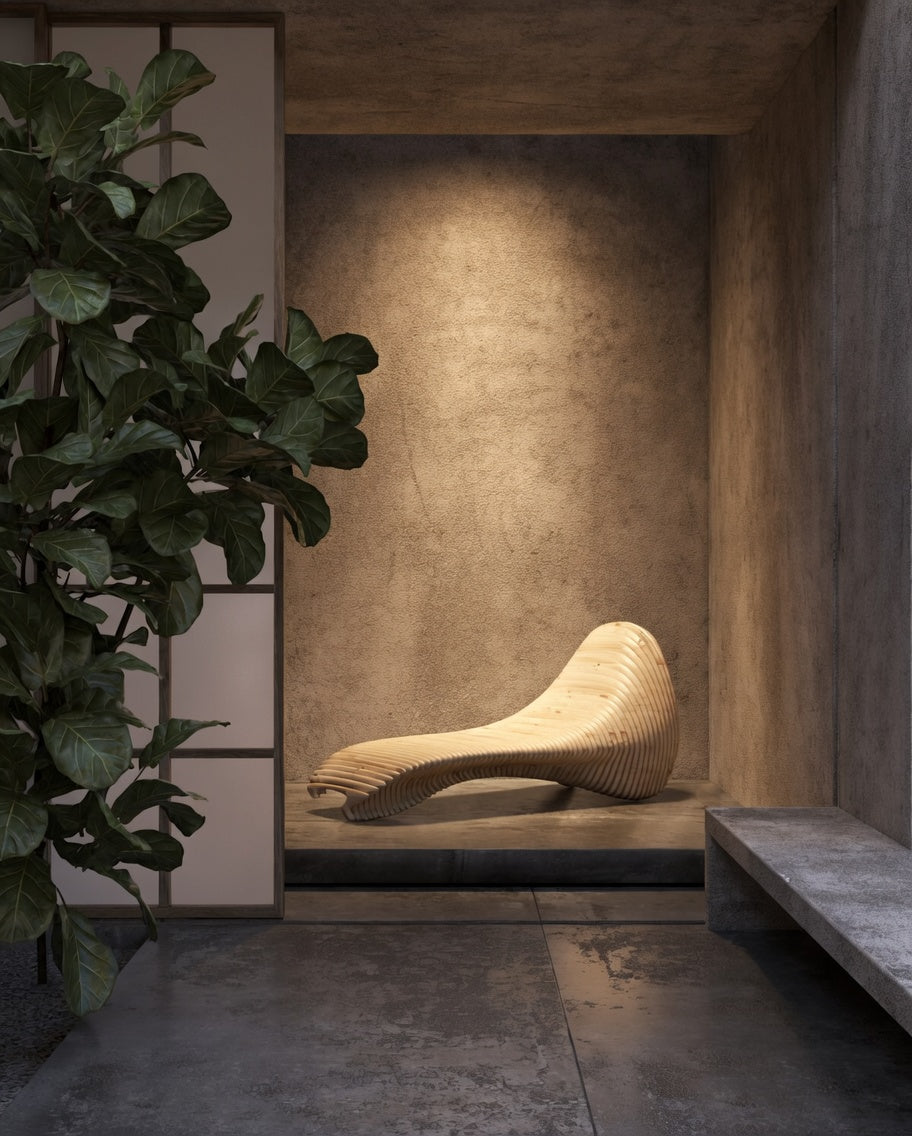
In my own practice, the Thoscene parametric algorithm was developed precisely around this integration — encoding sacred geometric proportional principles into the generative rules of the system so that the forms it produces carry both the structural intelligence of parametric optimisation and the proportional resonance of sacred geometric tradition. The furniture and spatial objects that emerge from it are not designed in the conventional sense. They are grown — from mathematical rules that mirror the intelligence of natural systems.
Environmental Intelligence
The most immediately significant application of parametric design to the future of architecture is environmental. Buildings are responsible for approximately forty percent of global energy consumption. The primary driver of this consumption is the mismatch between building form and environmental condition — buildings designed without adequate consideration of solar geometry, prevailing wind, thermal mass requirements, and the specific microclimate of their sites, requiring mechanical systems to compensate for what the architecture itself should have resolved.
Parametric design addresses this directly. A parametric system can incorporate the full solar geometry of a specific site — the sun's path across the sky at every hour of every day of the year at the building's precise latitude — and optimise the building's form, orientation, and facade porosity in response to it. The result is a building whose form is a direct expression of the environmental intelligence of its location — whose overhangs shade exactly what needs shading, whose openings admit exactly the light and air that the interior requires, whose thermal mass is distributed exactly where the diurnal temperature variation of the site demands it.
This is not theoretical. It is being done — in the facade systems of Herzog and de Meuron, in the environmental skins of the most sophisticated contemporary practice, in the structural and environmental optimisation tools that are becoming standard in serious architectural offices. The barrier is not technical. It is cultural — the willingness to let environmental intelligence rather than formal preference determine the primary decisions of a building's design.
Structure as Form
The structural system of a building has historically been something to be hidden — the thing that makes the building stand, concealed behind the surfaces that make it beautiful. Parametric design is dissolving this separation. When a structural system is optimised parametrically — when its form is determined by the actual distribution of forces through the building rather than by convention or intuition — the result is a structure whose form is simultaneously its most efficient structural expression and its most powerful architectural statement.
The branching column systems of parametric structural design — forms derived from the load-path logic of the building, each branch subdividing in response to the diminishing load it carries as the structure fans outward from its support points — are among the most compelling architectural forms of the current moment. They are compelling not because they are unusual but because they are true. Because their form is a direct expression of the forces moving through them. Because they look the way they do for reasons that are simultaneously structural, mathematical, and aesthetic — and those three things are, when the design is working at its best, the same reason.
This is the deepest architectural potential of parametric design. Not the production of complex forms for their own sake but the revelation of the intelligence already present in the structural and environmental requirements of a building — the making visible of logics that conventional design conceals behind conventional forms.
Material Intelligence
Parametric design is also transforming the relationship between architecture and material. The computational tools now available allow architects to specify not just the form of a building but the internal material organisation of its structural elements — the precise distribution of material through a cross-section in response to the actual stress distribution at that point in the structure.
This produces forms that look organic because they follow the same logic that living organisms use to grow structural tissue. Bone is dense where stress is highest and progressively less dense where stress decreases — a material distribution that maximises structural efficiency while minimising material use. Parametrically optimised structural elements follow the same logic. They are not designed to look like bone. They look like bone because they are doing what bone does — distributing material where it is needed and removing it where it is not.
The materials available to contemporary parametric architecture extend this intelligence further. Engineered timber systems whose grain orientation is specified parametrically in response to the stress distribution of the structure. Concrete whose mix design varies through the cross-section in response to the thermal and structural requirements of different zones. Facade panels whose geometry is individually optimised for their specific position on the building skin — their angle, their porosity, their reflectivity — in response to the precise solar and wind conditions at that location.
Every element different. Every difference justified. The building as a single continuous act of intelligent response to the full complexity of its conditions.
The Human Question
There is a question that parametric design raises that is worth sitting with seriously. If the form of a building is generated by a system of mathematical rules rather than chosen by a human designer, what is the role of the architect? What remains of authorship, of vision, of the particular quality of intelligence and sensibility that we associate with the greatest architectural work?
The answer, I think, is that the role becomes more demanding rather than less. The parametric system does not design the building. It generates the most intelligent response to the rules it has been given. The architect's responsibility is to give it the right rules — to encode into the generative system the full depth of their understanding of structure, environment, material, spatial experience, and the particular quality of life the building is intended to support. The intelligence of the output is a direct function of the intelligence of the input.
This is authorship at a higher level of abstraction. Not the choice of a form but the design of a system capable of finding the best possible form given the full complexity of the conditions it faces. It requires more knowledge, more philosophical depth, and more genuine understanding of the principles underlying architecture than conventional design does. The parametric tool amplifies the architect's intelligence. It does not replace it.
What Is Being Built Toward
The future of parametric architecture is not more complex facades or more spectacular structural gymnastics. It is buildings that are more completely intelligent — that respond more fully to the environmental, structural, material, and human conditions of their making, and that express that intelligence in forms that are simultaneously more efficient and more beautiful than what conventional design can achieve.
Buildings that grow from their sites the way organisms grow from their environments — shaped at every scale by the specific conditions they face, optimised across every dimension simultaneously, carrying in their forms the visible evidence of the intelligence that produced them.
Buildings that embody sacred geometric proportional principles not as applied decoration but as the generative logic of their form — so that the proportional resonance that the human nervous system evolved to recognise as beautiful is present at every scale from the overall massing to the finest material detail.
Buildings that are alive in the sense that matters most — not metaphorically but architecturally. Fully responsive. Fully intelligent. Fully present to the conditions of their making and the needs of the people inside them.
That is what parametric design is building toward. And the distance between where we are and where that destination lies is closing faster than most of the profession has yet understood.

De John Brevard