Sacred Geometry in Interior Design: The Architecture of Resonance
Sacred Geometry in Interior Design: The Architecture of Resonance
There is a proportion that keeps appearing throughout the natural world. In the spiral of a nautilus shell. In the arrangement of seeds in a sunflower head. In the branching of a river delta seen from altitude. In the distance between the joints of a human finger. It is called the golden ratio — approximately 1.618 — and it has been appearing in the work of architects and designers for thousands of years not because it is fashionable but because spaces built around it feel, to the human body, fundamentally right.
This is where sacred geometry begins. Not in mysticism. Not in historical nostalgia. In the observable fact that certain proportions and patterns produce measurable effects on human beings — that the body responds to mathematical relationships before the mind has time to form an opinion about them.
If that premise interests you, everything that follows from it is worth paying attention to.
What Sacred Geometry Actually Is
The phrase carries more baggage than it deserves. For some people it suggests New Age spirituality. For others, ancient temples and esoteric symbols. Both associations miss the point.
Sacred geometry is simply the study of the mathematical patterns that appear consistently throughout natural systems — the proportional relationships, the recursive structures, the self-similar forms that govern how matter organises itself from the scale of a crystal to the scale of a galaxy. The word sacred was attached to these patterns by cultures that recognised in them something that felt more fundamental than human invention. Not sacred in a religious sense. Sacred in the sense of belonging to the deep structure of things.
What makes these patterns relevant to interior design is not their historical or spiritual significance. It is their effect on the people who inhabit spaces built around them. Proportions derived from the golden ratio produce rooms that feel resolved — neither cramped nor wasteful, neither too low nor oppressively high. Patterns based on the Fibonacci sequence create visual rhythms that the eye follows naturally, without effort or fatigue. Forms that echo the structural logic of natural systems — the branching tree, the expanding spiral, the hexagonal cellular structure — feel both familiar and profound, because the human nervous system evolved in relationship with exactly these forms over millions of years.
This is not theory. It is the accumulated evidence of thousands of years of human habitation across dozens of distinct cultures, all of which independently arrived at similar proportional systems — because the human body kept telling them what worked.
The Room Before the Room
Before a single material is chosen or a piece of furniture selected, the most important design decisions have already been made. The proportions of the room. The height of the ceiling relative to its width and length. The size and placement of openings. The relationship between solid and void. The direction from which natural light enters and the angle at which it strikes the primary surfaces.
These decisions are invisible in the finished space — you cannot point to them the way you can point to a piece of furniture or a surface finish — but they determine everything. They are the difference between a room that settles you and a room that, despite its apparent beauty, never quite lets you rest.
When I begin working on an interior environment, I spend more time on these invisible decisions than on any visible ones. I am looking for the proportional relationships that will make the space feel inevitable — as if it could not have been any other way, as if the room has always existed and we simply uncovered it. That quality of inevitability is not accidental. It is the result of working from mathematical principles that have been tested by human experience across centuries.
The golden ratio. The Fibonacci sequence. The geometric relationships encoded in the Platonic solids. These are not design references in the way that a particular chair or a specific material palette is a design reference. They are the underlying grammar of the space — the rules that determine how everything else within it will be read and felt.
Pattern as Environment
A surface pattern in a room is not decoration. Or rather, it is never only decoration. It is an environmental condition — a continuous low-level input to the visual and nervous systems of everyone in the space. And the difference between a pattern that energises and one that exhausts, between one that rewards sustained attention and one that fatigues it, comes down almost entirely to its underlying mathematical structure.
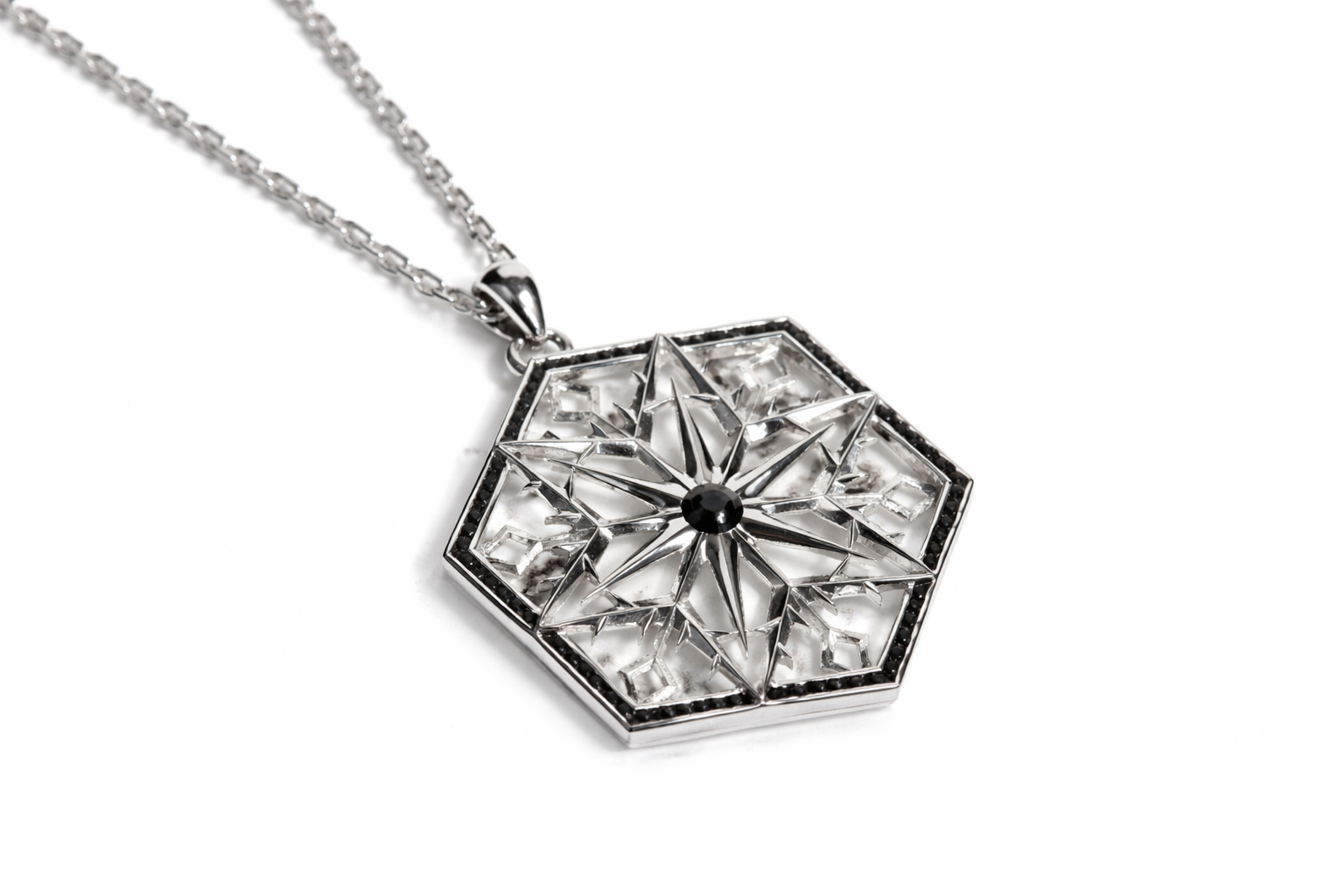
Patterns derived from sacred geometric principles — the Sri Yantra, the Flower of Life, the recursive triangular structures of fractal geometry — have a specific quality that distinguishes them from purely ornamental pattern: they contain multiple levels of organisation simultaneously. The eye can read them at the scale of the whole or zoom into a detail and find equivalent complexity. They do not resolve into a single reading. They remain open, generative, inexhaustible.
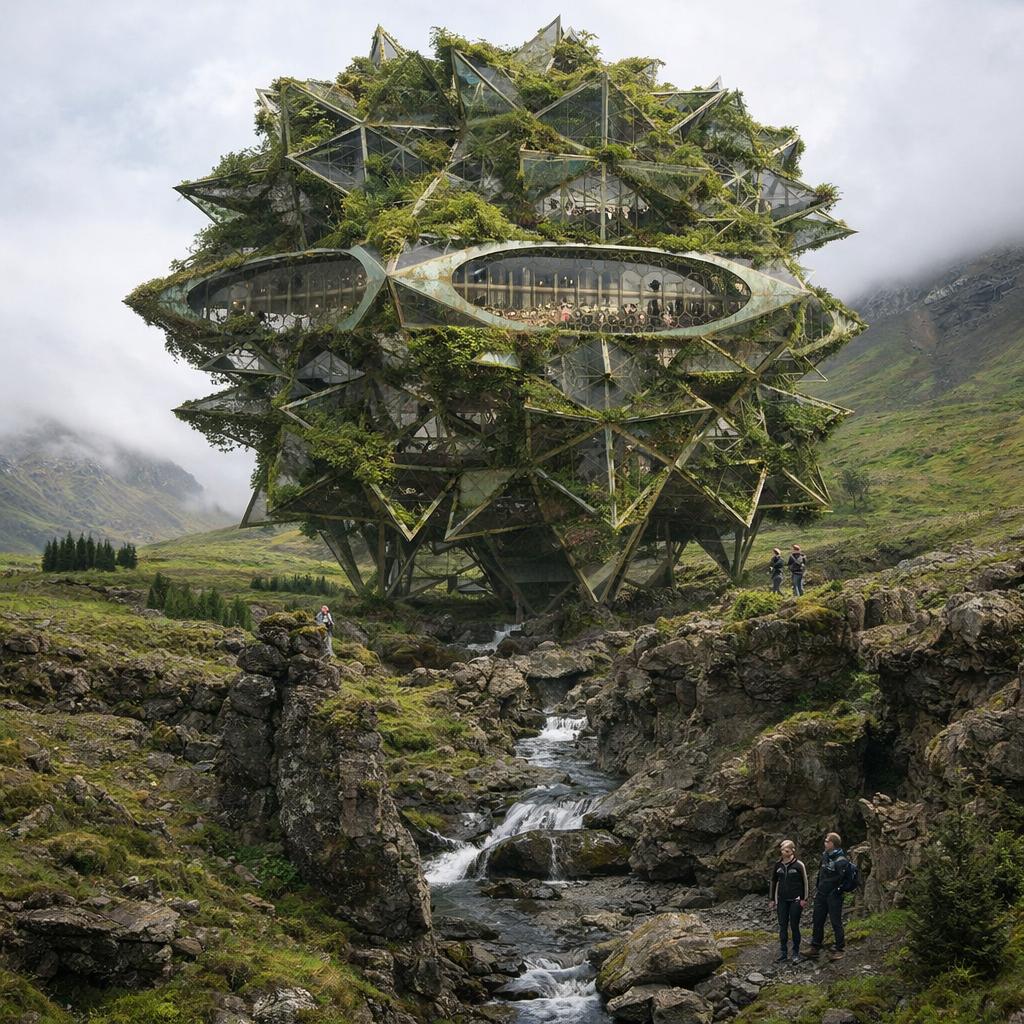
This quality is not coincidental. It mirrors the structural logic of natural systems — the way a forest is complex at every scale from the whole canopy to the individual leaf to the cellular structure of the wood — and the human visual system, which evolved to navigate exactly this kind of multi-scale environment, responds to it with a specific kind of pleasure that is closer to recognition than to appreciation.
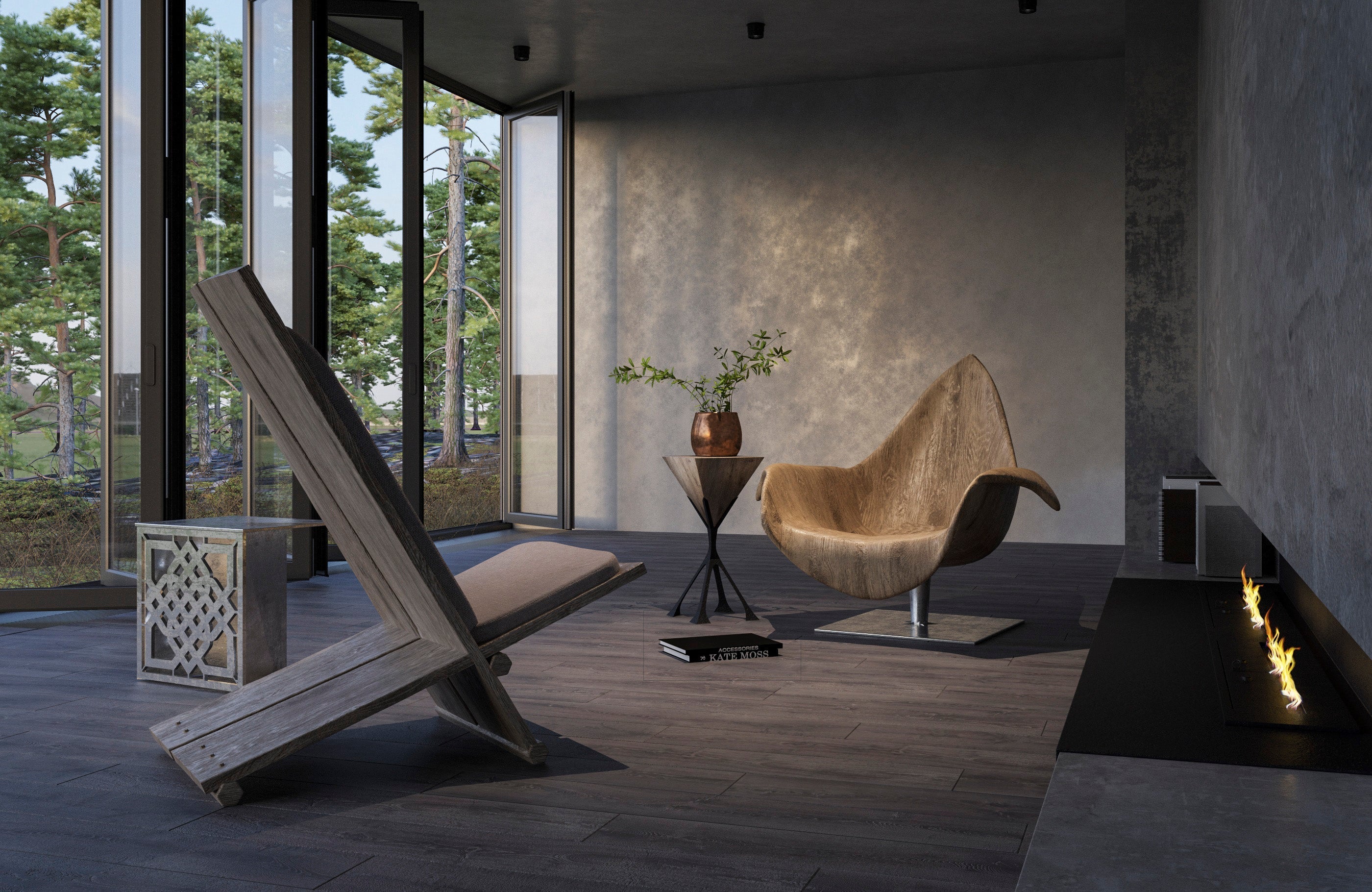
I have worked with these patterns across carved teak bookshelves, laser-cut steel, hand-etched table surfaces, and cast metal bases. In each case the pattern is not applied to the object as a finish. It emerges from the object's structure — is inseparable from it — the way grain is inseparable from wood. This distinction matters enormously. Pattern that is applied sits on the surface of an object and eventually exhausts itself. Pattern that is structural continues to reward attention indefinitely.
The Sacred Geometry of Empty Space
The most powerful application of sacred geometric principles in interior design is often the least visible — the deliberate structuring of empty space.
In Japanese spatial philosophy, the concept of ma describes the meaningful pause between things — the gap between notes in music, the space between objects in a room, the interval of silence that gives what came before it its full weight. This is not emptiness as absence but emptiness as presence — space that has been shaped and placed with as much intention as the objects around it.
A room designed around sacred geometric principles uses negative space the way a composer uses silence — as an active element of the composition, not a passive background to it. The void between two objects is as carefully proportioned as the objects themselves. The empty wall is as considered as the one that carries a work of art. The space beneath a table, the gap above a shelf, the interval between a window and the object nearest to it — all of these are opportunities to create proportion, to establish rhythm, to give the eye and the mind the breathing room they need to fully receive what is there.
This is counterintuitive in a design culture that tends toward fullness, toward the demonstration of taste through accumulation. But the spaces that genuinely rest and restore the people inside them are almost always the ones that have had things taken away rather than added — that have been edited down to the proportional relationships and material presences that actually matter.
Materials That Carry the Pattern
Sacred geometry in interior design does not require the literal use of geometric pattern everywhere. Its deeper application is in the selection of materials whose natural structure already embodies the principles — and the placement of those materials in relationships that allow their inherent geometry to speak.
Ancient petrified wood carries within its grain the record of a biological system that was growing and self-organising for decades before it began its geological transformation. The pattern of that grain is a fractal record of living intelligence — more complex and more beautiful than anything a designer could impose upon it, and completely unique to the particular tree, the particular forest, the particular century in which it grew.
Raw limestone carries the compressed record of marine organisms — shells, coral, microscopic creatures — whose calcium structures accumulated over millions of years into the geological formation we now cut and polish and build with. The pattern on its surface is a cross-section through deep time.
Hand-cast zinc, poured around organic forms and allowed to cool in its own way, produces surfaces whose texture is determined by the physics of molten metal and the geometry of whatever it encased — surfaces that carry the mathematical logic of fluid dynamics and thermal contraction, visible to anyone who looks closely enough.
These materials do not need sacred geometry imposed upon them. They are sacred geometry — expressions of the same mathematical intelligence that governs the natural world, made visible in the materials of the space.
The designer's job, working with materials like these, is restraint. To place them with enough space and enough light that their inherent intelligence can be perceived. To resist the temptation to compete with them. To understand that the most powerful design decision is often to simply get out of the way.
Why This Matters Now
We are living through a period of unprecedented environmental complexity. The designed world has become so dense with information, so saturated with visual stimulation, so relentlessly optimised for the capture of attention that the spaces we inhabit are frequently working against us — accelerating the nervous system when it needs to slow down, fragmenting attention when it needs to consolidate, feeding appetite when it needs to rest.
Sacred geometry in interior design is not a historical reference or an aesthetic preference. It is a response to this condition. A commitment to building spaces that work with the biology of the human being rather than against it. That use proportion, pattern, material, and light not to impress or to signal but to genuinely support the full range of human experience — thought, rest, connection, solitude, creativity, stillness.
The spaces that will matter most in the decades ahead will not be the ones that generated the most coverage or sold for the highest prices. They will be the ones that people lived better inside. That made them more present, more capable, more themselves.
Sacred geometry is simply the most rigorous toolkit available for building those spaces. It has been tested across more human lifetimes than any other design system. And it keeps working — because the human body has not changed, and the mathematics of the natural world has not changed, and the relationship between them remains exactly what it has always been.
The Last Word
Every space is making an argument about what a human life is for. Most spaces make that argument carelessly, by default, without ever having consciously chosen to make it.
The architecture of sacred geometry makes it deliberately. It argues that a human being is not simply a consumer of visual experience but a full sensory and spiritual organism — one that deserves spaces proportioned to the full depth of what they are.
Build from that premise and everything changes. The room stops being a container and becomes a condition. A condition for thinking more clearly, resting more deeply, feeling more completely, and living — however briefly, however imperfectly — in alignment with the intelligence that made you.
That is what a room is for.

Written by John Brevard