The Philosophy of Fractal Jewelry: Wearing the Mathematics of Everything
The Philosophy of Fractal Jewelry: Wearing the Mathematics of Everything
There is a piece of jewelry that does something unusual. It does not simply sit against the skin. It speaks — quietly, persistently, at a frequency beneath the level of conscious attention — about the structure of the world you are moving through. About the mathematical intelligence that underlies every visible thing. About the relationship between the scale of a human body and the scale of the universe it inhabits.
This is what fractal jewelry, designed with genuine philosophical intention, is capable of. Not ornament. Not status. A physical concentration of mathematical truth, worn at the most intimate possible distance from the person who chose it.
The Mathematics You Are Already Made Of
Before fractal jewelry can be understood as a design proposition, it needs to be understood as a physical one. The human body is a fractal system. The branching of the lungs — from the primary bronchi through progressively finer subdivisions to the alveolar sacs where gas exchange occurs — follows fractal geometry across more than twenty levels of scale, producing the maximum possible surface area within a finite volume. The branching of the circulatory system follows the same logic. So does the neural architecture of the brain. So does the structure of the kidney, the liver, the retina.
You are, at the level of your basic biological architecture, a fractal organism. The mathematics that governs your growth, your structure, and your function is the same mathematics that governs the branching of rivers, the formation of coastlines, the distribution of galaxies across the observable universe. You did not choose this. Evolution arrived at fractal organisation because it is the most efficient solution to the biological problems your body is solving — maximum surface area, minimum material, optimal distribution across every scale simultaneously.
This is where fractal jewelry begins. Not with an aesthetic preference but with a recognition. When you wear a piece of jewelry whose form is derived from fractal geometric principles, you are not decorating yourself with an interesting pattern. You are wearing the mathematics you are already made of. Placing against your skin a physical expression of the organisational intelligence that built you.
Self-Similarity and the Question of Scale
The defining property of a fractal form is self-similarity — the repetition of the same organisational logic across multiple scales simultaneously. The same structural relationship that governs the largest elements of the form governs the smallest. You can zoom into a fractal and find, at every level of magnification, the same quality of intelligence, the same proportional relationships, the same formal logic that characterises the whole.
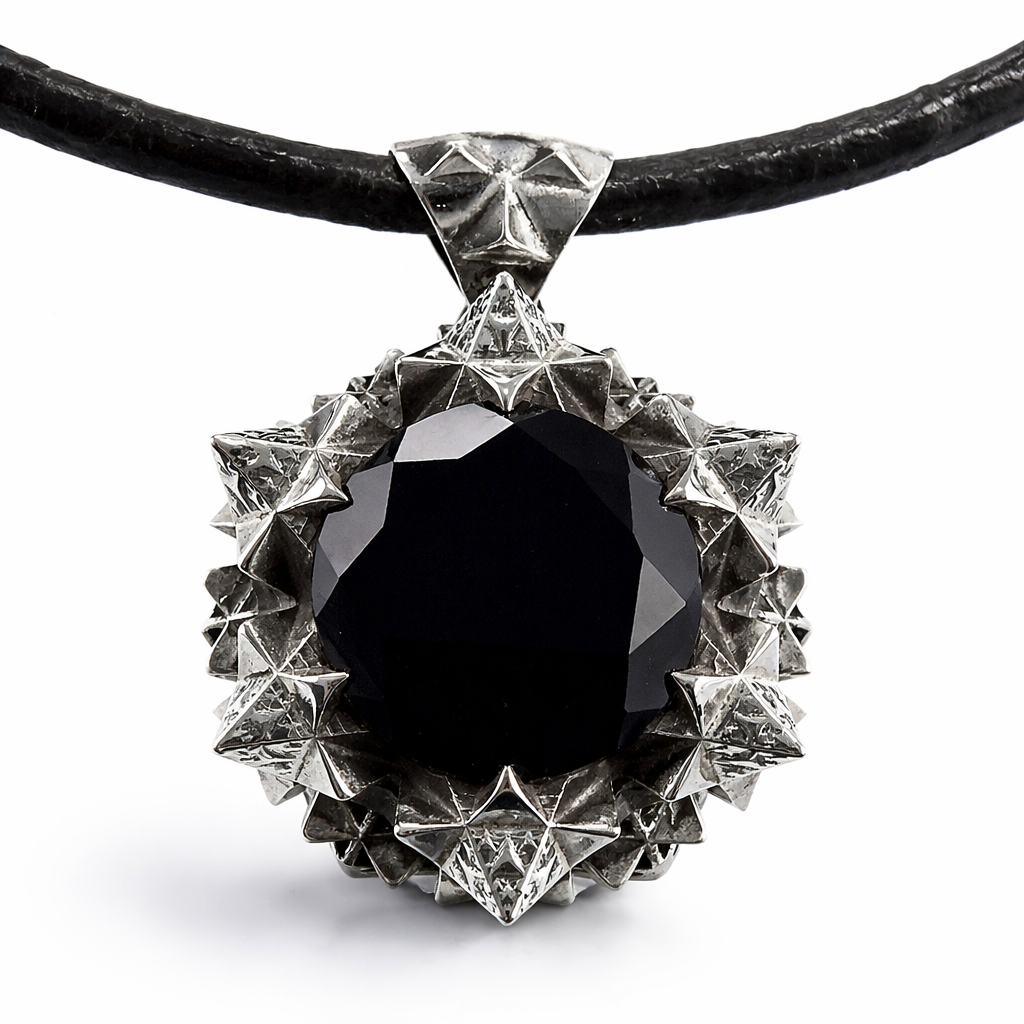
This property produces, in objects designed around fractal principles, the quality of inexhaustibility that I described earlier in the context of luxury design. A fractal piece of jewelry cannot be fully read in a single glance. The overall form resolves into a reading. The medium-scale detail reveals a more complex one. The finest elements — visible only when the piece is held close in strong raking light — carry the same organisational intelligence as the whole, but at a scale of resolution that rewards the closest possible attention.
This is the quality that distinguishes a piece of jewelry worth wearing for a lifetime from one worth wearing for a season. Not its visual impact, which is immediate and therefore immediately exhaustible. But its depth — the amount of the piece that remains undiscovered after the first encounter, that continues to reveal itself as the relationship between the wearer and the object deepens over years of acquaintance.
Fractal geometry provides this depth structurally rather than accidentally. It is not a matter of adding more detail in the hope that it will sustain interest. It is a matter of designing the detail according to the same principles that govern the whole — so that every level of examination is as intelligently resolved as every other, and the piece remains inexhaustible because its intelligence genuinely extends to every scale at which attention can reach.
Sacred Geometry as the Foundation
Fractal jewelry designed with genuine philosophical depth draws its generative principles not from arbitrary mathematical systems but from the sacred geometric tradition — the accumulated human understanding of the mathematical relationships that appear most consistently throughout the natural world and produce the most resonant aesthetic experience in the people who encounter them.
The golden ratio as the governing proportion of the overall form. The Fibonacci sequence as the logic of subdivision — each level of detail related to the one above it through the same ratio that relates the whole to its largest part. The recursive geometry of the Flower of Life or the Sri Yantra as the structural basis for surface pattern — generating complexity through the consistent application of simple rules rather than through the accumulation of arbitrary detail.
These are not design choices made for their visual effect. They are design choices made for their mathematical truth — for the fact that these proportional relationships have been found, across thousands of years of human observation, to produce the most resonant aesthetic experience and to correspond most precisely to the mathematical organisation of the natural systems that the human nervous system evolved to perceive as beautiful.
When fractal jewelry is designed from this foundation — when every proportional decision, every level of recursive detail, every relationship between element and whole is governed by sacred geometric principles — the resulting piece carries a quality that purely intuitive or trend-responsive design cannot replicate. It resonates with something in the person who wears it that is older and deeper than aesthetic preference. Something biological. Something that recognises the mathematics as familiar because it is the mathematics of their own body.
The Material as Philosophy
The philosophical depth of fractal jewelry is not only in its geometric structure. It is in the materials through which that structure is realised — and the relationship between the mathematics of the form and the physical character of the material that embodies it.
Recycled silver carries within its material history a fractal logic of its own. The crystalline structure of metal — the branching grain boundaries that form as molten silver cools and solidifies — is itself a fractal record of a thermal process, the same branching logic appearing at the scale of the overall crystal structure and at the scale of the individual grain boundary. A piece of fractal jewelry cast in recycled silver is a fractal at two simultaneous scales — the designed geometric structure imposed by the maker and the natural crystalline fractal generated by the physics of the material itself.
This relationship between designed fractal and material fractal is one of the most powerful available to the jewelry designer working with philosophical intention. When the geometry of the design and the geometry of the material are in dialogue — when they share a structural logic that makes each a different expression of the same underlying principle — the resulting piece has a unity and a depth that pieces designed without regard for this relationship cannot achieve.
Ancient coral cast in recycled zinc. Petrified wood inlaid against raw cast metal. Rough-faceted stone set within a parametric metal framework whose branching structure mirrors the crystalline structure of the stone at a different scale. In each case, the material is not simply a medium for the design. It is a participant in it — carrying its own fractal intelligence into relationship with the designed fractal of the geometric form.
Wearing a Frequency
There is a dimension of fractal jewelry philosophy that goes beyond the mathematical and the material into territory that is harder to name but no less real for that difficulty.
The objects we choose to carry against our bodies are not neutral. They participate in our experience of the world. Not in any magical sense — but in the straightforward sense that the things we wear are continuously present in our peripheral awareness, continuously contributing to the sensory and aesthetic environment of every moment of our daily lives. The quality of that contribution — the frequency, to use a word that carries more precision than it might initially seem — matters.
An object whose form is derived from the mathematical principles that govern the structure of the natural world carries a particular frequency. Not a metaphysical one. A perceptual one. The micro-experiences of glancing at it, of feeling its weight and texture against the skin, of catching it in a mirror or seeing it reflected in a window — these contribute, accumulated across the hours and days of wearing it, to a continuous low-level encounter with mathematical beauty. With the proportional intelligence of living systems. With the reminder, however subtle, that the world is organised according to principles of extraordinary elegance and that you are, in your own structure, an expression of those same principles.
This is what I mean when I say that fractal jewelry designed with genuine philosophical intention is not ornament. It is a form of orientation — a daily recalibration toward the mathematical intelligence that underlies the visible world, worn at the closest possible distance from the person doing the recalibrating.
The Responsibility of the Maker
Designing fractal jewelry with genuine philosophical depth is a more demanding practice than it might appear. The fractal principle is simple to invoke and difficult to genuinely embody. A piece can have fractal-looking surface detail without fractal structural intelligence — can carry the visual language of self-similarity without the mathematical reality of it. The difference is immediately perceptible to sustained attention and completely invisible to a casual glance.
The responsibility of the maker working with these principles is to ensure that the fractal intelligence of the piece is genuine — that it operates at every scale of examination, that the finest details are as proportionally resolved as the largest elements, that the relationship between the designed geometry and the material in which it is realised is considered rather than incidental.
This requires a combination of mathematical understanding, craft skill, and philosophical seriousness that is rare in any design discipline. The mathematical understanding to encode genuine sacred geometric principles into the generative logic of the piece. The craft skill to realise those principles in material with the precision they demand. And the philosophical seriousness to understand what is at stake — to recognise that a piece of jewelry designed with this level of intention is not simply a beautiful object but a physical argument about the structure of the world, worn against the pulse of the person who chose it.
That is a significant thing to make. It deserves to be made with full attention, full knowledge, and full care. Anything less is not fractal jewelry. It is fractal decoration. And the difference between them is everything

من قِبل John Brevard