
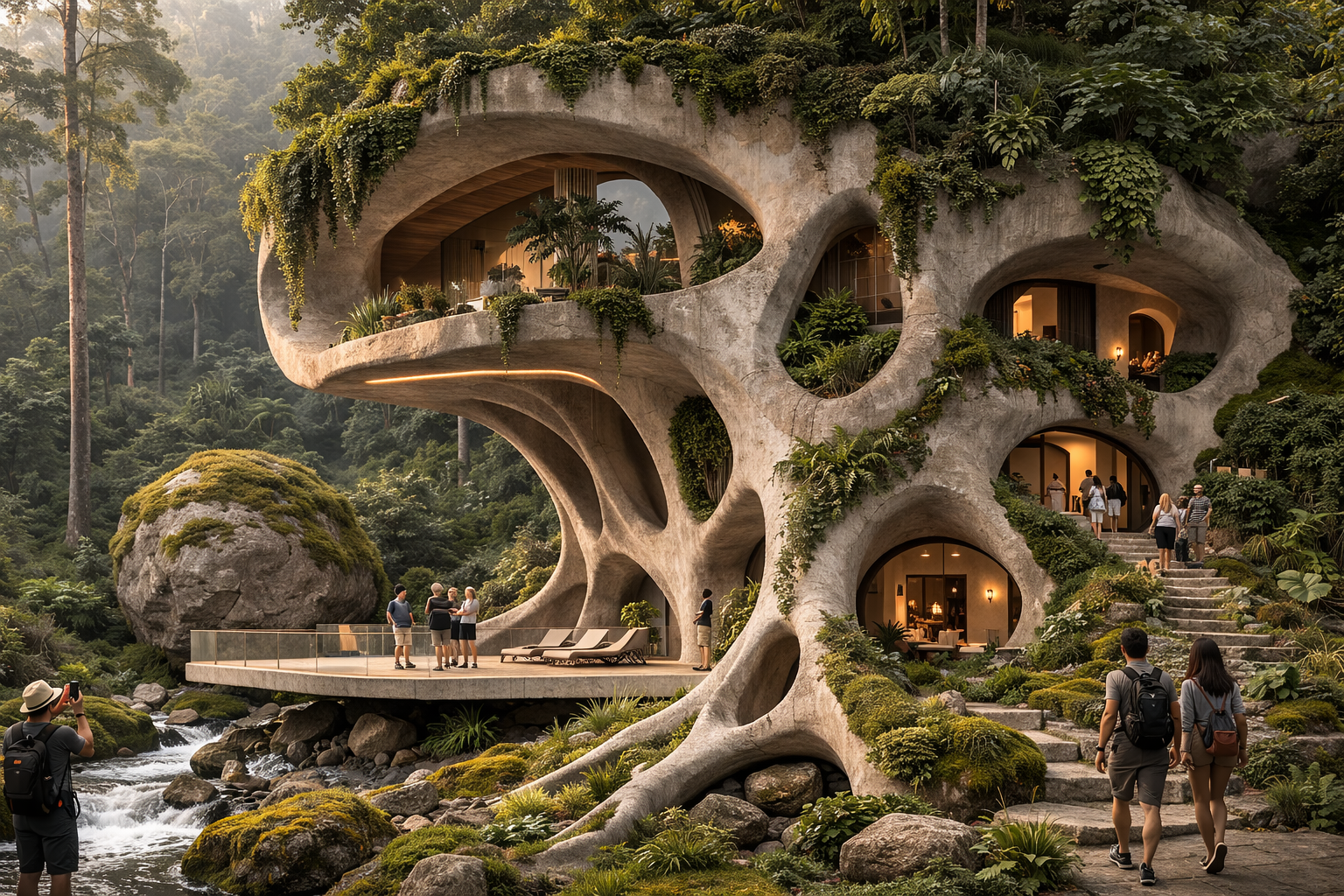
Sacred Geometry in Architecture
Sacred Geometry in Architecture
By John Brevard
Architecture is often described as frozen music. But if that’s true, then sacred geometry is the underlying rhythm—the invisible structure that gives the composition coherence, harmony, and meaning.
For thousands of years, civilizations have intuitively understood that certain proportions, patterns, and relationships feel “right.” Not because they are trendy or imposed, but because they are deeply embedded in nature itself. From the spiral of a shell to the branching of trees, from the structure of crystals to the proportions of the human body—geometry is the language through which life organizes itself.
Sacred geometry is not decoration. It is not surface-level symbolism. It is a system of order that connects the physical world to something more subtle—something experiential, even emotional.
Geometry as a Living System
When I approach architecture, I don’t see walls, floors, and roofs as isolated elements. I see them as part of a field—a system of relationships.
Sacred geometry provides a framework for this system.
The Golden Ratio, for example, is not just a mathematical curiosity. It is a proportional logic that creates balance between parts and whole. When applied to architecture, it can subtly influence how a space feels—whether it feels calm or chaotic, expansive or compressed.
Similarly, fractal geometry—patterns that repeat at different scales—can create environments that feel alive. Spaces that mirror nature’s complexity tend to resonate more deeply with us because they reflect the way we are wired to perceive the world.
This is not mystical thinking. It is perceptual intelligence.
Beyond Minimalism: Toward Meaning
Modern architecture has often leaned toward reduction—clean lines, minimal forms, stripped-down aesthetics. While there is beauty in simplicity, something has been lost in the process.
Spaces have become efficient, but not always meaningful.
Sacred geometry reintroduces meaning—not through ornamentation, but through structure. It creates spaces that are not only visually refined but also experientially rich.
A wall is no longer just a boundary. It becomes part of a larger proportional system.
A window is not just an opening. It becomes a calibrated interaction between light, scale, and rhythm.
This approach does not reject minimalism—it elevates it.
The Human Experience of Space
Most people cannot articulate why a space feels good. But they know it when they feel it.
A well-proportioned room can feel calming without explanation.
A poorly proportioned one can feel unsettling, even if it looks visually “correct.”
Sacred geometry operates at this intuitive level.
It aligns architecture with human perception—not just visually, but psychologically. It creates coherence between the body, the mind, and the environment.
In this way, architecture becomes more than shelter. It becomes a medium for experience.
Imperfection and the Wabi-Sabi Principle
While sacred geometry is often associated with precision, it does not require perfection.
In fact, some of the most powerful spaces emerge when geometric order is paired with material imperfection.
Wabi-sabi—the Japanese philosophy that embraces transience and imperfection—adds a necessary counterbalance. It softens geometry. It humanizes it.
A perfectly proportioned space made of raw stone, textured plaster, or aged wood carries a different energy than one made of polished perfection.
It feels grounded. Real. Alive.
This tension—between order and imperfection—is where architecture begins to breathe.
Designing for the Future
As we move into an era shaped by technology, speed, and constant stimulation, the role of architecture becomes even more important.
We need spaces that reconnect us.
Spaces that slow us down.
Spaces that remind us of something deeper than utility.
Sacred geometry offers a path forward—not as a stylistic choice, but as a foundational principle.
It allows us to design environments that are not only functional and beautiful, but also aligned—with nature, with perception, and with something that feels timeless.
Final Thought
The goal is not to make architecture more complex.
The goal is to make it more coherent.
When geometry, material, and intention align, a space begins to transcend its physical boundaries. It becomes something you don’t just see—but something you feel.
And that is where architecture begins to matter.

من قِبل John Brevard