Architecture Inspired by Nature: When Buildings Stop Imposing and Start Learning
Architecture Inspired by Nature: When Buildings Stop Imposing and Start Learning
The most important shift available to contemporary architecture is not technological. It is philosophical. It is the shift from understanding the natural world as a backdrop for human construction to understanding it as the most sophisticated design intelligence available — one that has been solving the problems of structure, environment, material, and spatial experience for four billion years with a consistency and an elegance that human ingenuity has never matched and is only beginning to approach.
Architecture inspired by nature — genuinely inspired, at the level of principle rather than appearance — is architecture that makes this shift. That stops asking what natural forms look like and starts asking how natural systems work. That brings to the design of human environments the same quality of intelligence that living systems bring to the design of themselves.
The results are among the most significant buildings of the current moment. And the principles behind them are older than architecture itself.
The Two Kinds of Nature-Inspired Architecture
There is a distinction worth making at the outset because it determines everything that follows. Nature can inspire architecture in two fundamentally different ways — and the difference between them is the difference between decoration and intelligence.
The first way is visual. The building that looks like a tree, the facade that references a leaf, the column that evokes a branch. This is nature as aesthetic resource — a library of forms to be borrowed and translated into architectural language. It has produced beautiful buildings. It has also produced a great deal of work that is visually interesting and intellectually empty — that carries the appearance of natural intelligence without any of its substance.
The second way is structural. The building whose support system distributes load the way a tree distributes wind force. The facade whose geometry manages solar gain the way a desert animal manages heat. The urban system whose resource flows operate the way a forest ecosystem operates. This is nature as intellectual resource — a library of solutions to problems that architecture keeps facing, developed through a process of evolutionary optimisation so rigorous and so extended that no human design process can match it.
The most significant nature-inspired architecture of the current moment is working in the second mode. Learning from natural systems rather than referencing natural forms. Using the intelligence of the natural world rather than its appearance.
Structure That Grows
The structural systems of living organisms are among the most materially efficient solutions to load-bearing problems that exist. Not because they were designed to be — but because they evolved to be, through a process that eliminated every solution less efficient than the current one across millions of generations of testing against physical reality.
A tree in a storm is a structural lesson of extraordinary sophistication. The primary trunk receives the wind load and distributes it progressively through each level of branching — each branch absorbing a portion of the force and redirecting the remainder to the next subdivision, the load diminishing at every level until the finest twigs are moving freely in the wind that would tear an equivalently sized rigid structure apart. The system works because it is hierarchically distributed — because the same load-distribution logic operates at every scale, from the whole tree to the finest twig, with the same structural intelligence at every level.
The parametric branching column systems appearing in the most structurally sophisticated contemporary architecture apply this principle directly. Each column divides in response to the actual load it is carrying — more branches where more load must be distributed, finer subdivisions where loads are smaller — producing structural forms that look organic because they are following the same logic that natural structures use. The Stuttgart Airport departure hall. The British Museum Great Court. The increasingly sophisticated branching systems appearing in the work of practices that have fully integrated parametric structural optimisation into their design process.
These structures are compelling architecturally not because they look like trees — though they do — but because they are true. Because their form is a direct expression of the forces moving through them. And that truth, perceived before it is understood, is what produces the particular quality of aesthetic satisfaction they provide.
Surfaces That Breathe
The surfaces of living organisms are environmental management systems of extraordinary sophistication. The skin of a building — its boundary with the external environment — is the primary determinant of its thermal performance, its relationship to light, its acoustic behaviour, and its energy consumption. And the surfaces of living organisms have been optimised for precisely these functions across timescales that dwarf architectural history.
The pinecone opens and closes in response to humidity — a passive, mechanically elegant response to environmental change requiring no energy input, no sensors, and no control systems. The principle has been applied to facade systems whose apertures open and close in response to temperature and humidity, regulating the building's internal environment through the same passive logic that the pinecone uses. The Thematic Pavilion at the Yeosu Expo in South Korea used a facade system derived directly from this principle — panels that open and close like scales in response to environmental conditions, the building's skin alive in the same sense that an organism's skin is alive.
The honeycomb — whose hexagonal cellular geometry achieves the maximum structural efficiency for a given quantity of material, providing the greatest possible stiffness per unit of mass — is the structural principle behind some of the most materially efficient building panel systems available. Not because the honeycomb looks architecturally interesting, though it does. Because it represents the optimal solution to the problem of creating a lightweight rigid panel — a solution that bees arrived at through evolutionary optimisation and architects are now deliberately applying.
The termite mound — whose internal geometry maintains a constant temperature despite extreme external variation through a system of passive ventilation requiring no mechanical input — is the model for the passive environmental systems appearing in the most energy-intelligent contemporary architecture. The Eastgate Centre in Harare remains the most widely cited example. But the principle is being applied with increasing sophistication across a growing range of building types and climate zones, as architects develop the computational tools to model and optimise passive environmental systems with the precision that genuine application of the principle requires.
Materials That Remember
Beyond structure and surface, the material intelligence of natural systems offers lessons for architecture that are only beginning to be seriously explored. Living materials — materials that grow, self-repair, and respond to their environments — represent a frontier of architectural possibility whose implications are genuinely transformative.
Mycelium — the root-like network of fungal organisms — can be grown into precise forms using agricultural waste as its substrate, producing structural materials that are simultaneously biodegradable, carbon-negative, and competitive with conventional insulation and panel materials in thermal and acoustic performance. The material grows rather than being manufactured — its structural properties emerging from the same biological processes that produce the complex material intelligence of natural systems.
Mass timber — the contemporary structural application of wood as a primary building material at scales previously reserved for steel and concrete — is the most widely adopted architectural application of natural material intelligence. Cross-laminated timber panels whose grain orientation is engineered in response to the specific stress distribution they will carry. Glulam structural members whose lamination pattern mirrors the distribution of forces through the cross-section. Timber structures that sequester carbon throughout their service life rather than emitting it during manufacture. The structural intelligence of wood — its remarkable strength-to-weight ratio, its acoustic properties, its thermal behaviour — being applied at architectural scale with a precision that was unavailable before contemporary computational and fabrication tools.
Ancient natural materials — petrified wood, raw stone, hand-cast metals — carry a different kind of material intelligence: the accumulated record of geological and biological processes that produced them over timescales that architecture can reference but never replicate. A floor of ancient limestone carries within its surface the compressed record of the marine organisms that accumulated into the geological formation from which it was cut. A structural element in petrified wood embodies the cellular geometry of a living organism fossilised in stone over hundreds of millions of years. These materials bring into the spaces built from them a temporal depth that manufactured materials cannot provide — a material connection to the deep history of the natural world that recalibrates the human sense of scale in ways that are felt before they are understood.
The Garden as Architecture
The most sophisticated nature-inspired architecture does not simply borrow intelligence from natural systems. It integrates natural systems directly into the architectural proposition — understanding the living landscape not as a setting for the building but as a constitutive element of it.
The Japanese tradition of borrowed scenery — shakkei — in which the garden is designed to frame and incorporate the natural landscape beyond its boundaries, making distant mountains or forest canopy a visual element of the garden composition — is the most elegant available model for this integration. The architecture does not compete with the natural environment. It enters into conversation with it — directing attention toward specific views, framing specific moments of the landscape, creating a dialogue between the made and the found that gives both more meaning than either would have alone.
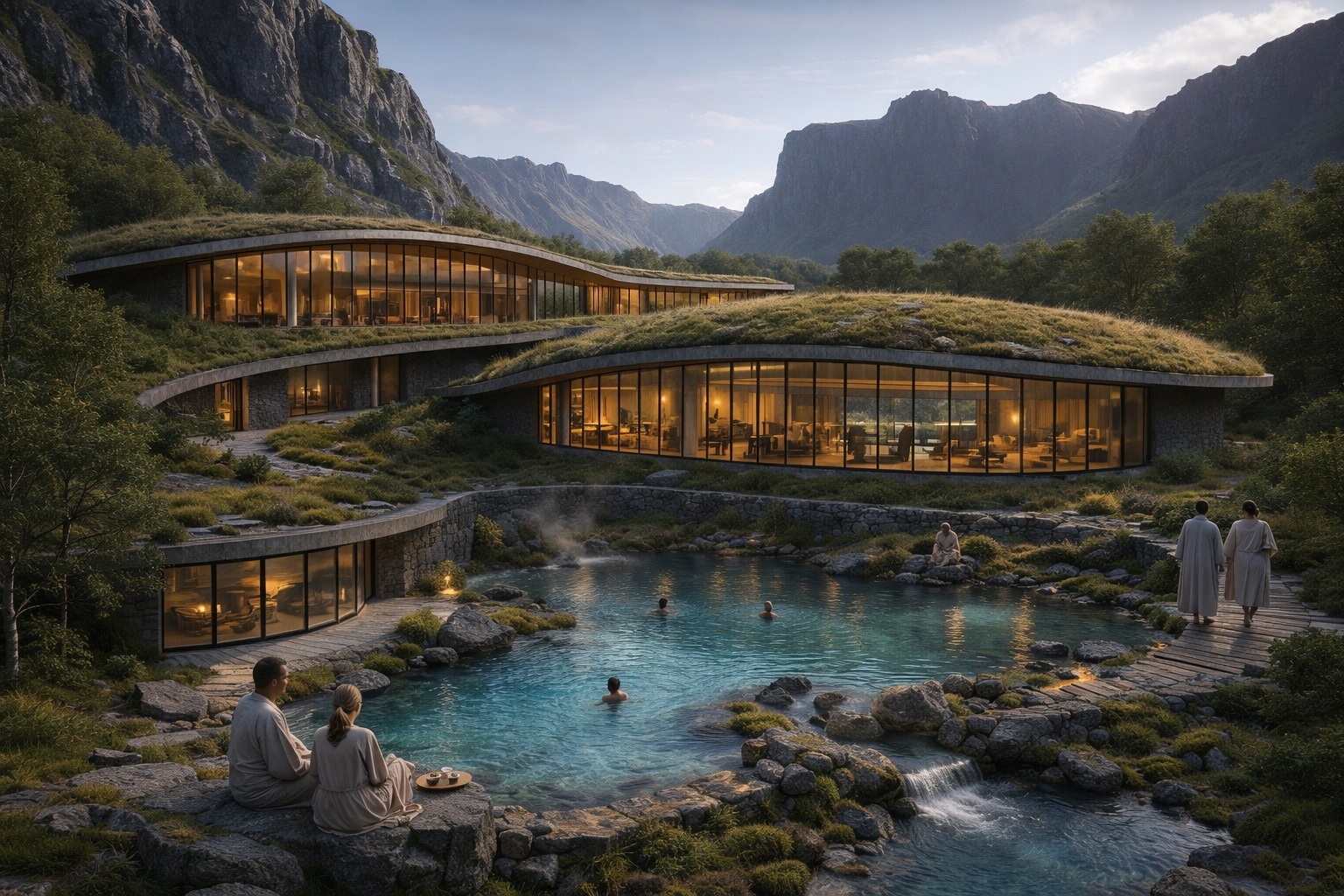
The contemporary application of this principle goes beyond visual integration. The building that manages its own stormwater through designed landscapes of absorbent planting and permeable surface. The facade whose planted elements contribute to the building's thermal performance through the same mechanisms of shading, evaporative cooling, and air filtration that natural vegetation provides in landscapes. The roof whose ecological habitat contributes to the biodiversity of the urban environment while managing the building's thermal load through the thermal mass and evaporative cooling of its growing medium.
These are not decorative gestures toward sustainability. They are functional integrations of natural intelligence into the architectural system — applications of the same principles that natural landscapes use to manage energy, water, and ecological function, implemented at the scale of the individual building with enough precision that they make a measurable difference to the building's environmental performance.
Sacred Geometry as Natural Intelligence
The connection between nature-inspired architecture and sacred geometry is the same connection that underlies both practices separately. Sacred geometric principles — the golden ratio, the Fibonacci sequence, fractal self-similarity — are not human inventions applied to natural forms. They are mathematical descriptions of the principles that natural systems use to organise themselves.
The golden ratio appears in living organisms because it is the mathematical expression of the growth process that produces self-similar forms — forms that can expand continuously without changing their fundamental proportional relationships. The Fibonacci sequence appears in plant growth because it produces the most efficient coverage of a growing surface. Fractal self-similarity appears throughout natural systems because self-similar structures achieve the maximum surface area within a finite volume — the most material-efficient solution to the biological problem of creating exchange surfaces.
Architecture that is inspired by nature at the level of principle — that applies the structural, environmental, and material intelligence of natural systems to the design of human environments — and that organises this intelligence according to sacred geometric proportional principles is architecture that is working from the deepest available foundation. Not the appearance of nature. Not the mathematics of nature in the abstract. But the specific ways in which natural systems apply mathematical intelligence to solve physical problems — and the proportional principles that make those solutions simultaneously structurally optimal and aesthetically resonant.
This is the architecture that feels most completely right. That the body says yes to before the mind has time to form an opinion. That is simultaneously the most intelligent response to its physical conditions and the most beautiful expression of its structural and material logic. Not because beauty was added to intelligence as a separate consideration. Because in work of this quality, they are the same thing.
What Nature Is Actually Offering
Nature is not offering architecture a set of forms to borrow. It is offering something far more valuable — a four-billion-year library of solutions to the problems of building, tested against the most demanding possible criterion of survival across geological time, and available to any architect willing to look carefully enough and think seriously enough to understand what they are seeing.
The branching tree. The termite mound. The nautilus shell. The lotus leaf. The mycelial network. The pinecone. Each one a specific, physically tested answer to a specific structural or environmental problem. Each one available for study, for understanding, for the extraction of principles that can be applied — in new materials, at new scales, in new contexts — to the design of human environments that are more intelligent, more efficient, and more genuinely beautiful than anything designed without this foundation.
The architects who are doing this most seriously — who are bringing genuine scientific understanding of natural systems to bear on the design of buildings, and organising that understanding according to the proportional intelligence of sacred geometric tradition — are producing the most significant architecture of the current moment.
Not the most spectacular. The most alive. And alive is the only standard worth building toward.

من قِبل John Brevard